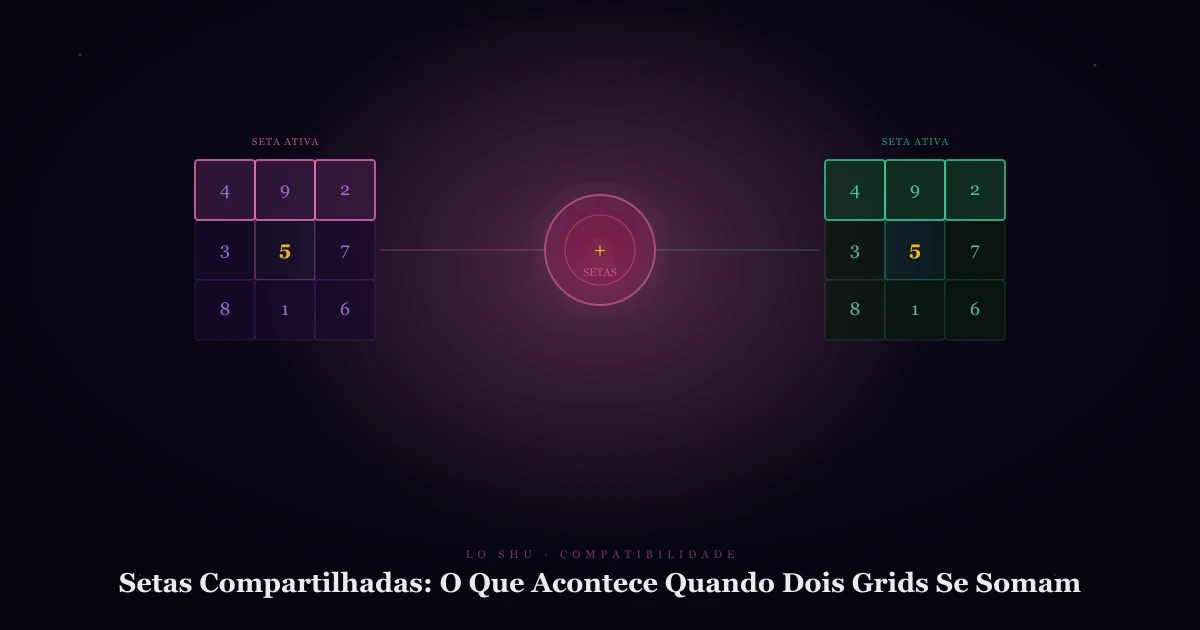
In the Lo Shu system, Arrows of Strength are formed when all three numbers of a row, column, or diagonal of the grid are present in a person's birth date. They indicate natural talents, developed abilities, and personality strengths. Arrows of Weakness, on the other hand, emerge when all three numbers of a row are absent — pointing to areas that need to be developed.
What Arrows Are in Lo Shu
The Lo Shu grid has 8 possible arrows: 3 horizontal rows, 3 vertical columns, and 2 diagonals. Each arrow that completes (Strength) or is completely empty (Weakness) has a specific meaning. For example, the top row (4-9-2) completed forms the Arrow of Intellect, while absent it forms the Arrow of Indecision.
How Arrows Interact in a Compatibility Reading
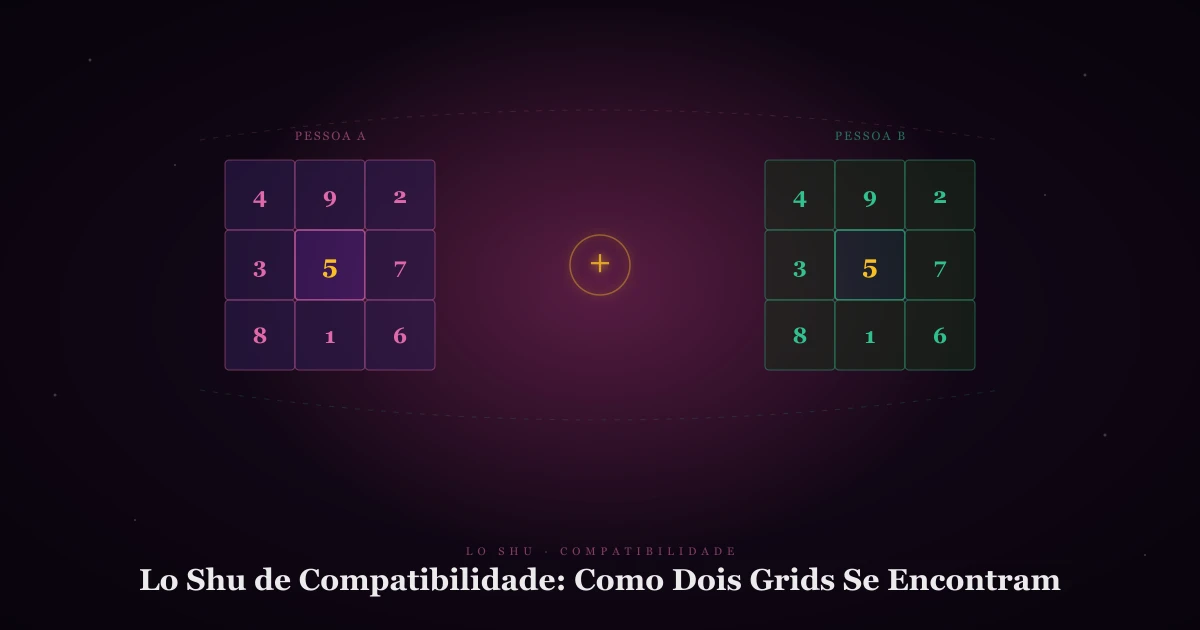
When two grids are read together for a compatibility reading, the arrows gain a new dimension. We can observe: which arrows both share (amplification), which arrows one has that the other doesn't (complementarity), and which arrows are absent in both (joint gap).
Shared Arrows: Amplification of Qualities
When both partners have the same Arrow of Strength, that quality is amplified in the relationship. For example, if both have the Arrow of Determination (4-3-8 — left column), the relationship tends to be extremely goal-focused, with great capacity for joint construction. The challenge is not becoming excessively rigid or resistant to change.
Complementary Arrows: What One Brings That the Other Doesn't
When one partner has an Arrow of Strength that the other doesn't, there is a natural exchange of abilities. That area of one person's competence complements the absence in the other. For example, a partner with the Arrow of Intuition (4-9-2 — top row) can help the other, who lacks this arrow, develop mental clarity and discernment.
Shared Arrows of Weakness: The Joint Challenge
When both partners have the same Arrow of Weakness (the three numbers of the row absent in both grids), this creates a shared energetic challenge. The relationship will need to find ways to consciously compensate for this gap. For example, both without the middle row (3-5-7) — the Arrow of Indecision — indicates the couple may struggle with flexibility and adaptive communication.
The 8 Arrows and Their Meanings in Compatibility
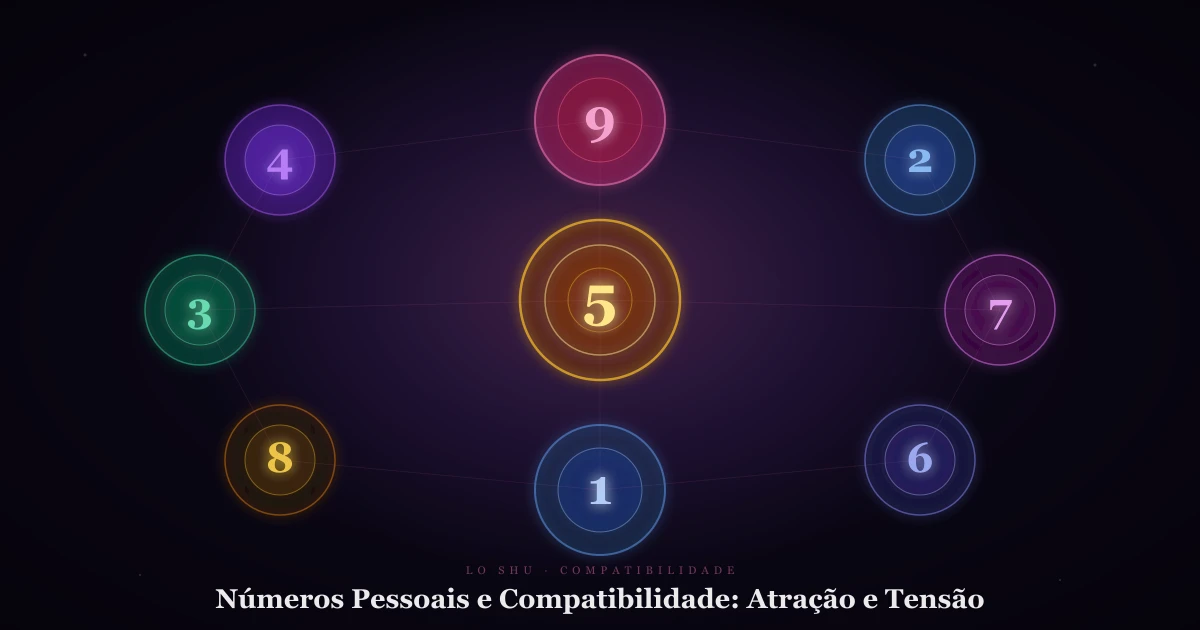
- Row 4-9-2 (Intellect): strength=mental clarity / absence=difficulty deciding
- Row 3-5-7 (Action): strength=adaptability / absence=rigidity or indecision
- Row 8-1-6 (Planning): strength=practical vision / absence=difficulty with goals
- Column 4-3-8 (Determination): strength=perseverance / absence=lack of focus
- Column 9-5-1 (Spirituality): strength=elevated purpose / absence=lack of inner direction
- Column 2-7-6 (Compassion): strength=care / absence=emotional difficulty
- Diagonal 4-5-6 (Balance): strength=harmony / absence=extremism
- Diagonal 2-5-8 (Will): strength=discipline / absence=inconsistency
Reading shared arrows reveals not just individual strengths and challenges, but the specific energetic quality the relationship creates when both people are together. It is a reading layer that goes beyond the individual and points to the relational field as a living organism with its own patterns and potentials.
How to study Shared Arrows in Lo Shu: What Happens When Two Grids Combine
Shared Arrows in Lo Shu: What Happens When Two Grids Combine is most useful when it is treated as a structured symbolic study rather than a shortcut to a prediction. This article adds a practical reading framework for the relationship between digits in a Lo Shu Grid: what to observe first, how to compare signals, and how to turn an interpretation into a question for reflection.
Start with the method, not the conclusion
Begin by defining the object of the reading. With the relationship between digits in a Lo Shu Grid, a meaningful interpretation comes from the relationship between the input, the position being examined, and the tradition used to assign meaning. The same number or image can change emphasis when its position changes, so a responsible reader names the method before offering an interpretation.
A practical reading sequence
A useful sequence is to map the visible structure, identify repetition or absence, compare the strongest signals, and only then write a synthesis. This order keeps the relationship between digits in a Lo Shu Grid grounded in observable features instead of encouraging a reader to select a keyword that confirms a prior belief.
- Name the question and the symbolic system being used.
- Describe the position, number, pattern, or relationship before interpreting it.
- Compare constructive and challenging expressions of the same symbol.
- Translate the reading into a concrete question or experiment for daily life.
What an example can and cannot show
An example of the relationship between digits in a Lo Shu Grid can demonstrate how the method works, but it cannot prove that one interpretation is universally true. Use examples to learn the grammar of the system: notice which information is present, what remains uncertain, and how different contexts might change the emphasis.
A reflective practice for readers
After studying the relationship between digits in a Lo Shu Grid, write two observations and one question. The observations should refer to the chart or method itself; the question should connect the symbol to a real situation without assuming that the symbol controls the outcome. Revisit the note later and record what you learned from experience.
- Observation: what pattern is actually visible?
- Context: where does this pattern appear in the person, relationship, or cycle?
- Choice: what small action could test a constructive expression of the theme?
Limits and responsible interpretation
Astro Lúdico presents the relationship between digits in a Lo Shu Grid as an educational and symbolic tool for self-reflection. It is not a scientifically validated prediction method and should not replace professional advice or a person’s own judgment. Keeping that boundary visible makes the reading more honest, more useful, and easier to compare with other perspectives.
- Treating a symbolic pattern as a fixed personality label.
- Ignoring the date, position, or calculation rule that produced the result.
- Using one isolated number to override the rest of the chart.
- Presenting an interpretive possibility as a medical, financial, legal, or relationship certainty.
Did this guide help you?
Astro Ludico is an independent project. Your support helps us create more free tools and educational content.
About the Author: Kelwin Felipe
Creator of Astro Lúdico, software developer and independent researcher in Cabalistic Numerology, dedicated to translating ancestral wisdom into practical and intuitive tools for self-knowledge.
Related Articles
Notice: The content on Astro Lúdico is for informational and educational purposes only, based on symbolic systems such as numerology and the Major Arcana. It does not constitute medical, psychological, legal, or financial advice. Tool results should be interpreted as reflections on symbolic energetic patterns, not as absolute truths.