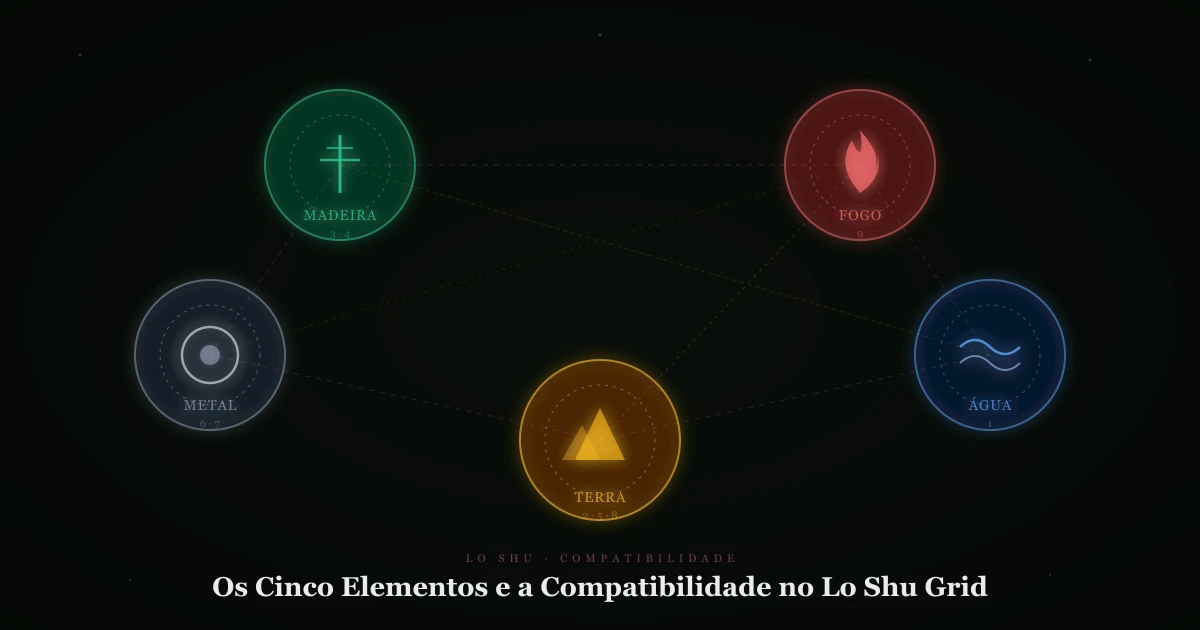
At the heart of Lo Shu numerology lies the theory of the Five Elements of Chinese cosmology: Wood, Fire, Earth, Metal, and Water. These elements are not just abstract categories — they describe patterns of movement, energetic quality, and interaction. When applied to compatibility, they reveal how two people naturally nourish, challenge, or balance each other.
The Five Elements and Lo Shu Numbers
Each number in the Lo Shu grid corresponds to one of the Five Elements: 1 = Water; 3 and 4 = Wood; 9 = Fire; 2, 5, and 8 = Earth; 6 and 7 = Metal. When two people share numbers, the elements interact according to two fundamental cycles: the Generation Cycle (nourishment) and the Control Cycle (regulation).
The Generation Cycle: Relationships That Nourish Each Other
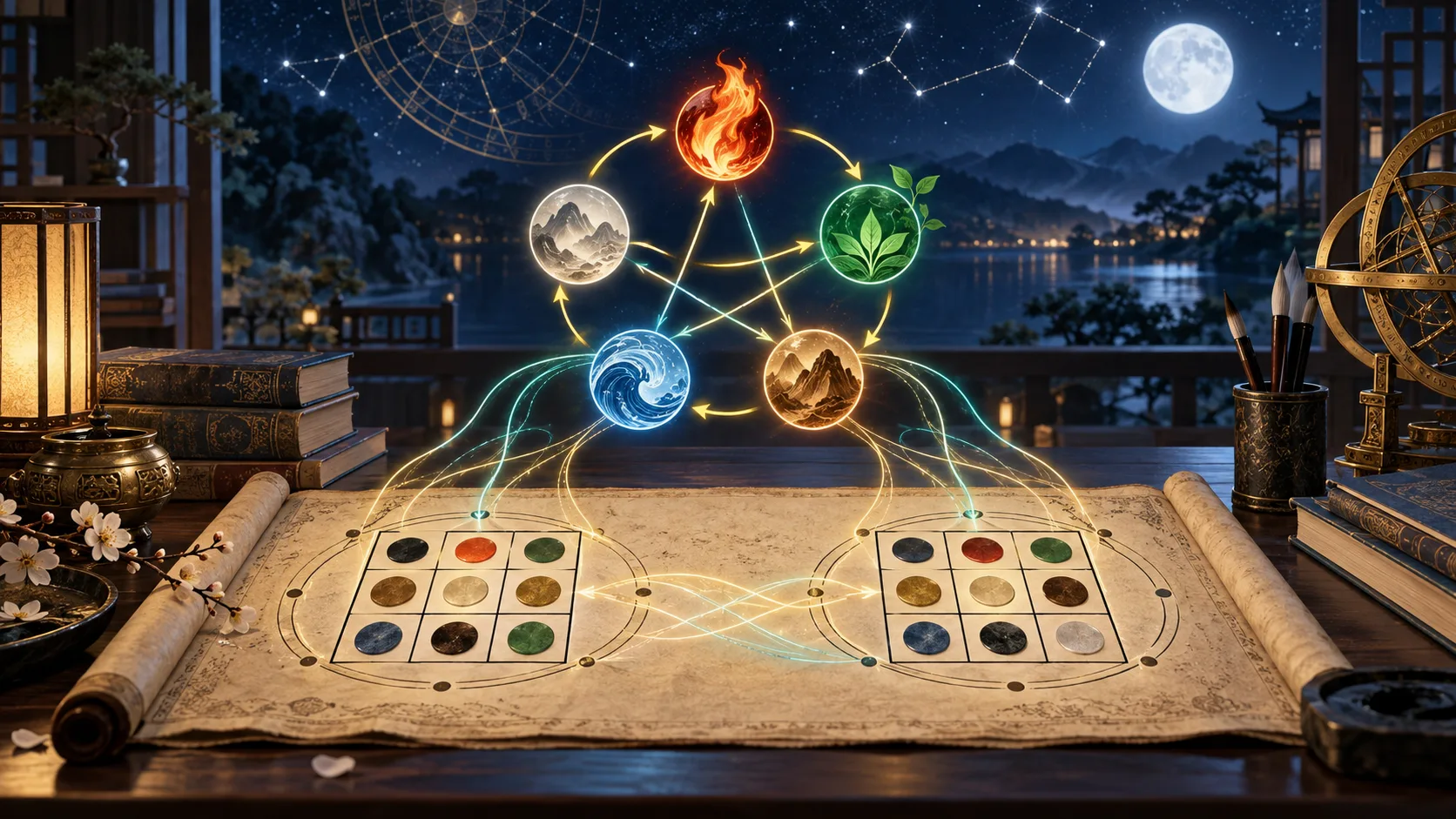
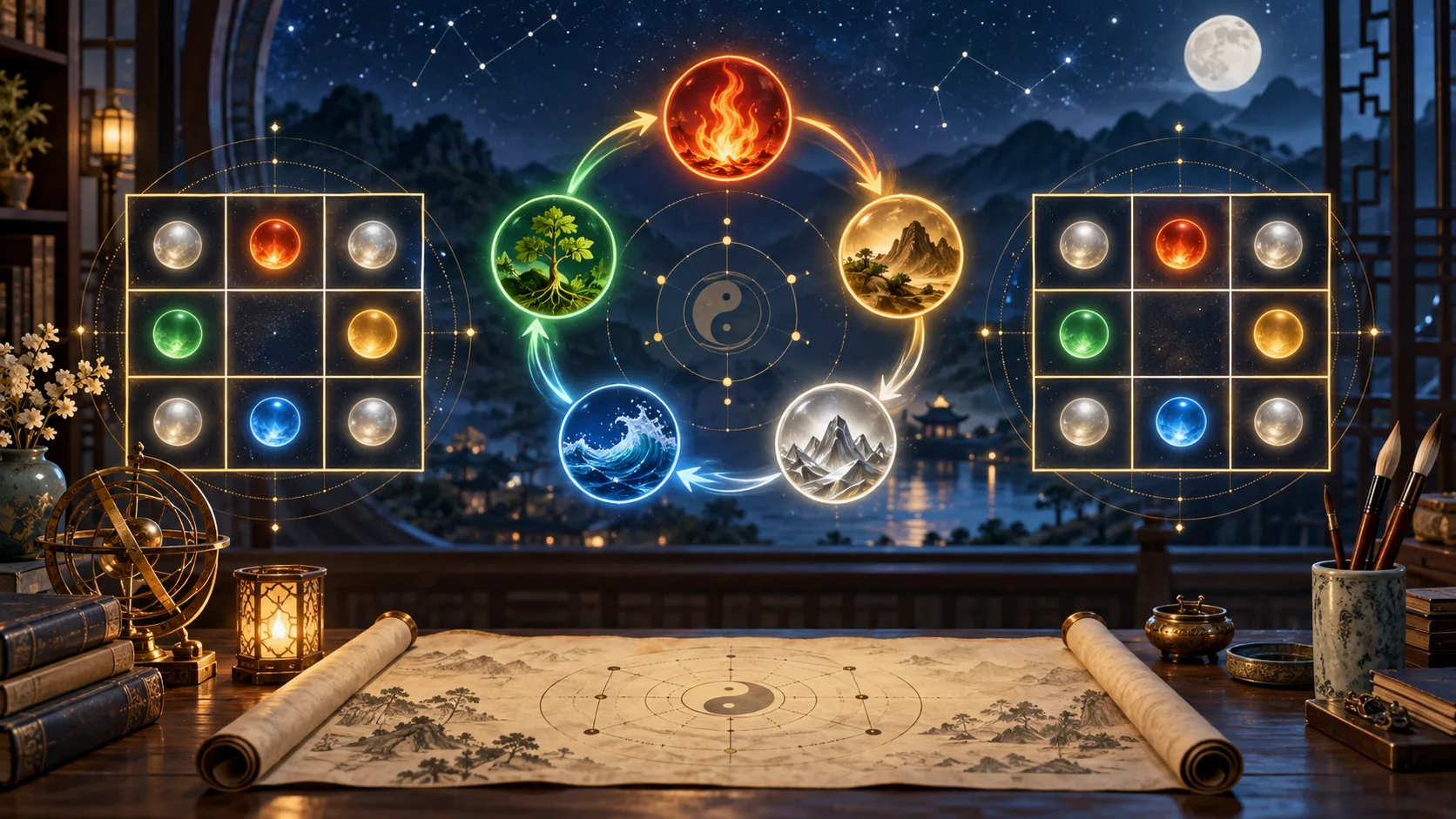
In the Generation Cycle, each element feeds the next: Water nourishes Wood, Wood feeds Fire, Fire generates Earth (ashes), Earth produces Metal, Metal generates Water (condensation). When the main elements of two partners follow this nourishment sequence, the relationship tends to have a natural flow of support and complementarity.
The Control Cycle: Relationships with Structural Tension
In the Control Cycle, elements regulate each other in opposition: Wood controls Earth, Earth controls Water, Water controls Fire, Fire controls Metal, Metal controls Wood. Relationships between elements in this position carry a structural tension — but also the possibility of growth through contrast.
How to Apply This in a Compatibility Reading
Step 1: Identify the dominant elements of each person
Look at each person's grid and see which elements appear most frequently (repeated numbers) and which are absent. The dominant element is the one with the most representation; the absent element is the challenge to develop.
Step 2: Analyze the interaction between the dominant elements
Compare the dominant elements of both people. Are they in the Generation Cycle (one nourishes the other)? In the Control Cycle (one regulates the other)? Are they of the same element (resonance)? Each configuration creates a different type of relational dynamic.
Classic Combinations and Their Dynamics
- Water + Wood: natural nourishment relationship. One person's depth feeds the other's growth.
- Wood + Fire: shared enthusiasm, vision and creativity. Risk of burning fast if there's no balance.
- Fire + Earth: heat transforms and stabilizes. One inspires, the other anchors.
- Earth + Metal: solid construction, high standards. Can be very rigid if there's no flexibility.
- Metal + Water: refinement and flow. A clear mind (Metal) generating emotional depth (Water).
- Fire + Water: maximum control tension. Intense, transformative relationship requiring maturity.
- Wood + Metal: cutting and growth. Creative tension that can be very productive with awareness.
Element Gaps in the Relationship
When both partners lack the same element, the relationship has an energetic blind spot. For example, if neither has Fire numbers (9), the relationship may lack enthusiasm, visibility, and expansion. Knowing this allows the pair to consciously seek activities, environments, and people that bring that energy.
The Five Elements offer a poetic and precise vocabulary for talking about compatibility. More than labels, they describe movements — and understanding the movements each person carries is the first step to creating a relationship that flows with more wisdom and intention.
How to study The Five Elements and Lo Shu Compatibility
The Five Elements and Lo Shu Compatibility is most useful when it is treated as a structured symbolic study rather than a shortcut to a prediction. This article adds a practical reading framework for the relationship between digits in a Lo Shu Grid: what to observe first, how to compare signals, and how to turn an interpretation into a question for reflection.
Start with the method, not the conclusion
Begin by defining the object of the reading. With the relationship between digits in a Lo Shu Grid, a meaningful interpretation comes from the relationship between the input, the position being examined, and the tradition used to assign meaning. The same number or image can change emphasis when its position changes, so a responsible reader names the method before offering an interpretation.
A practical reading sequence
A useful sequence is to map the visible structure, identify repetition or absence, compare the strongest signals, and only then write a synthesis. This order keeps the relationship between digits in a Lo Shu Grid grounded in observable features instead of encouraging a reader to select a keyword that confirms a prior belief.
- Name the question and the symbolic system being used.
- Describe the position, number, pattern, or relationship before interpreting it.
- Compare constructive and challenging expressions of the same symbol.
- Translate the reading into a concrete question or experiment for daily life.
What an example can and cannot show
An example of the relationship between digits in a Lo Shu Grid can demonstrate how the method works, but it cannot prove that one interpretation is universally true. Use examples to learn the grammar of the system: notice which information is present, what remains uncertain, and how different contexts might change the emphasis.
A reflective practice for readers
After studying the relationship between digits in a Lo Shu Grid, write two observations and one question. The observations should refer to the chart or method itself; the question should connect the symbol to a real situation without assuming that the symbol controls the outcome. Revisit the note later and record what you learned from experience.
- Observation: what pattern is actually visible?
- Context: where does this pattern appear in the person, relationship, or cycle?
- Choice: what small action could test a constructive expression of the theme?
Limits and responsible interpretation
Astro Lúdico presents the relationship between digits in a Lo Shu Grid as an educational and symbolic tool for self-reflection. It is not a scientifically validated prediction method and should not replace professional advice or a person’s own judgment. Keeping that boundary visible makes the reading more honest, more useful, and easier to compare with other perspectives.
- Treating a symbolic pattern as a fixed personality label.
- Ignoring the date, position, or calculation rule that produced the result.
- Using one isolated number to override the rest of the chart.
- Presenting an interpretive possibility as a medical, financial, legal, or relationship certainty.
Did this guide help you?
Astro Ludico is an independent project. Your support helps us create more free tools and educational content.
About the Author: Kelwin Felipe
Creator of Astro Lúdico, software developer and independent researcher in Cabalistic Numerology, dedicated to translating ancestral wisdom into practical and intuitive tools for self-knowledge.
Related Articles
Notice: The content on Astro Lúdico is for informational and educational purposes only, based on symbolic systems such as numerology and the Major Arcana. It does not constitute medical, psychological, legal, or financial advice. Tool results should be interpreted as reflections on symbolic energetic patterns, not as absolute truths.