On this page
- The Five Elements: Wood, Fire, Earth, Metal, Water
- How Each Lo Shu Number Associates with an Element
- Water Element — Number 1
- Wood Element — Numbers 3 and 4
- Fire Element — Number 9
- Earth Element — Numbers 2, 5, and 8
- Metal Element — Numbers 6 and 7
- How to Balance the Elements in Your Personal Grid
- A method check for Lo Shu Grid and the Five Elements: How Chinese Cosmology Lives in Your Numbers
- A question for your next reading
- A second pass through the grid context
The Lo Shu Grid has been part of Chinese cosmology for more than four thousand years. At its core, it is not just a numerological map — it is a reflection of how nature organizes itself. Long before it became a tool for personal reading, the Lo Shu was a sacred square that encoded the relationship between heaven, earth, and humanity. The Five Elements are the language through which that relationship speaks: every number in the grid carries an elemental charge, and understanding those charges transforms a grid reading from a list of traits into a living, breathing map of energy in motion.
The Five Elements: Wood, Fire, Earth, Metal, Water
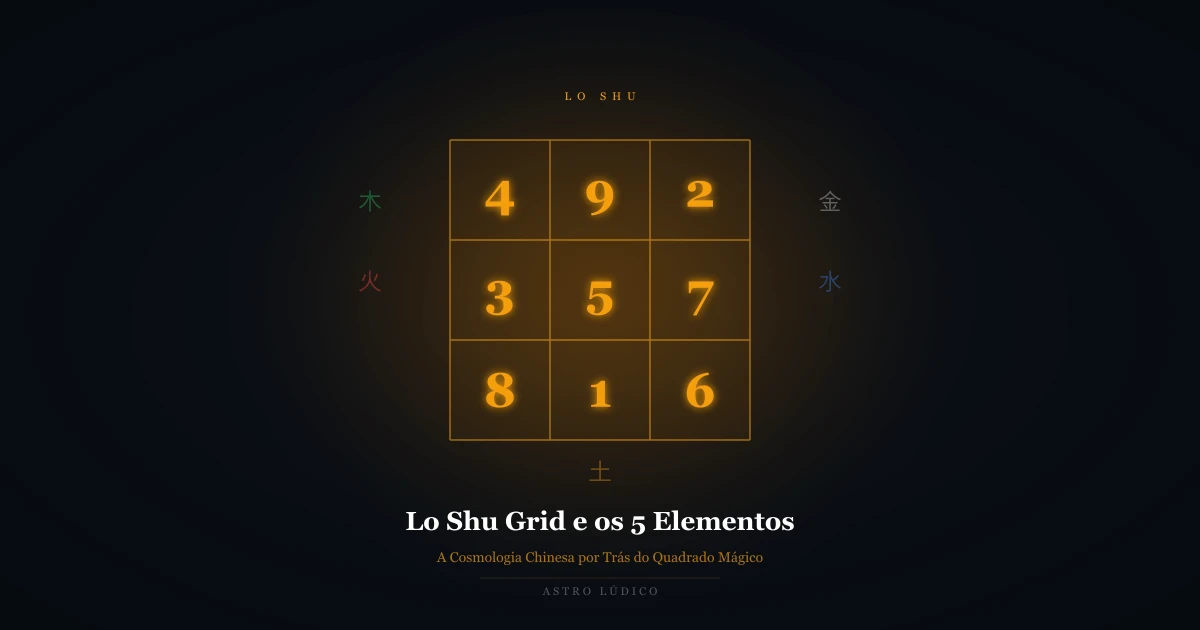
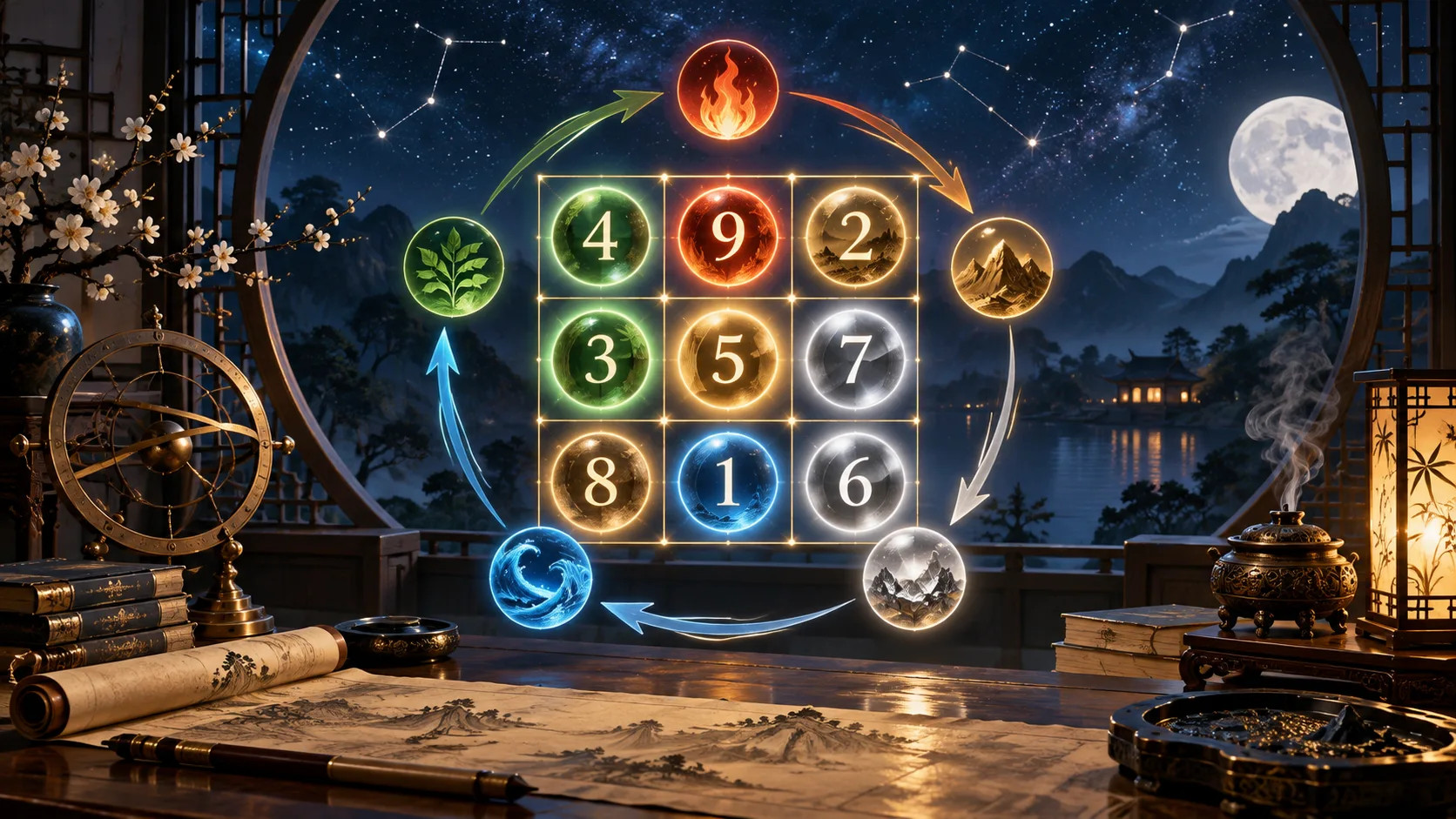
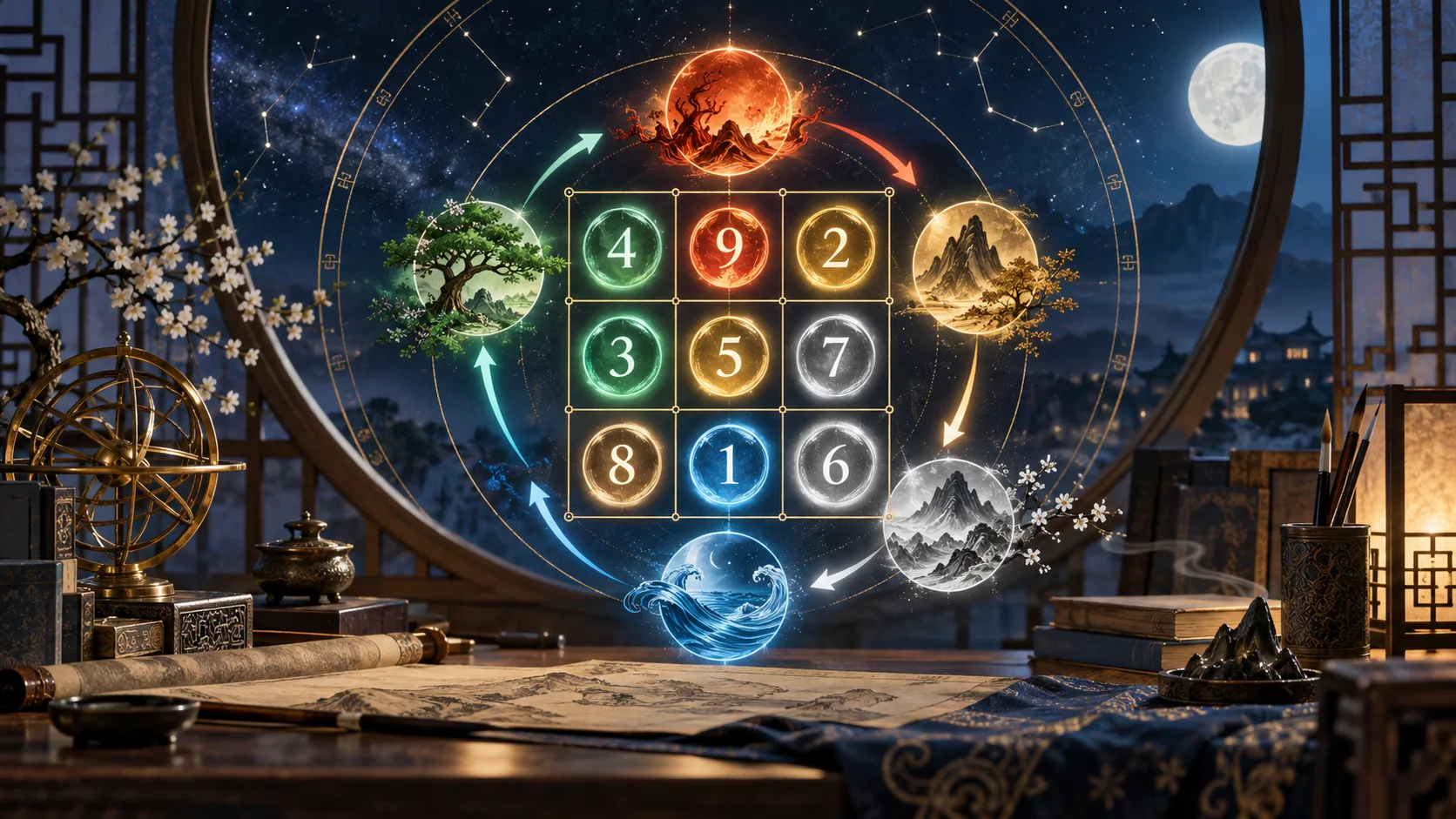
In Chinese cosmological thinking, the Five Elements are not substances but phases — qualities of energy that flow through all things in an ordered rhythm. They relate to each other through two fundamental cycles. In the generation cycle, Water feeds Wood, Wood feeds Fire, Fire creates Earth (ash), Earth produces Metal, and Metal condenses Water. In the control cycle, each element regulates another, keeping the system in balance. This means no element is inherently superior; the health of the whole depends on all five being present and in proportion.
- Wood: expansion, growth, creativity, new beginnings.
- Fire: passion, transformation, visibility, illumination.
- Earth: stability, nourishment, center, relationships.
- Metal: precision, discipline, letting go, spiritual clarity.
- Water: flow, adaptability, depth, wisdom, communication.
How Each Lo Shu Number Associates with an Element
Each of the nine numbers in the Lo Shu Grid belongs to one of the Five Elements. The associations are: 1 = Water; 2, 5, and 8 = Earth; 3 and 4 = Wood; 6 and 7 = Metal; 9 = Fire. This means that when you look at which numbers appear in someone's grid, you are also reading which elements are strong and which are absent. A person with multiple 3s and 4s is Wood-dominant — growth, creativity, and forward momentum define their energy. A person missing 9 has no Fire in their map — and may struggle with visibility, recognition, or passion until that element is consciously cultivated.
Water Element — Number 1
Flow, Adaptability, Wisdom, Career, and Communication
Number 1 is the only Water number in the Lo Shu system. Water flows around obstacles — it does not resist them. People with a strong 1 in their grid tend to be naturally communicative, adaptable, and intuitive. They find their way through situations by listening and adjusting rather than forcing. Water is also associated with career and the depth of inner life; when 1 is absent, the person may experience difficulty expressing themselves, navigating professional shifts, or trusting their own intuition. Cultivating Water means practicing stillness, deep listening, and allowing life to move through rather than being controlled.
Wood Element — Numbers 3 and 4
Growth, Creativity, Family, and Expansion
Numbers 3 and 4 carry the Wood element. Wood is the energy of spring — upward, outward, creative, and oriented toward the future. Number 3 brings expressive creativity, communication, and the impulse to connect with others. Number 4 brings a more structured form of creativity, focused on planning, discipline in creative work, and building roots that support growth. Together, they govern family dynamics, artistic expression, career expansion, and the ability to set and pursue goals. People strong in Wood tend to initiate easily but may struggle with completion; those missing Wood may feel stuck, uncreative, or disconnected from their sense of purpose.
Fire Element — Number 9
Passion, Recognition, Illumination, and Transformation
Number 9 is the sole Fire number in the grid and one of the most powerful positions. Fire is the element of visibility — it illuminates, transforms, and draws attention. People with a strong 9 carry a natural magnetism and a wide, expansive intelligence. They are often drawn to knowledge, philosophy, teaching, and the pursuit of meaning. Fire also governs recognition and social standing. When 9 is absent, the person may shy away from being seen, resist claiming their achievements, or feel uncertain about their place in the larger picture. Feeding Fire means embracing visibility, sharing knowledge, and allowing transformation rather than resisting change.
Earth Element — Numbers 2, 5, and 8
Stability, Nourishment, Center, and Relationships
Earth is the most represented element in the Lo Shu, carrying three numbers: 2, 5, and 8. Number 2 is associated with cooperation, sensitivity, and the nurturing of relationships. Number 5 sits at the center of the grid and governs the integration of all energies — it is the pivot point, the self at the center of experience. Number 8 brings practicality, ambition, and the capacity to build material stability. Earth people tend to be reliable, patient, and deeply relational, but they may struggle with overthinking, excessive caution, or difficulty letting go. When Earth is overdominant, the energy can become heavy and resistant to change.
Metal Element — Numbers 6 and 7
Precision, Leadership, Organization, and Spiritual Clarity
Numbers 6 and 7 carry the Metal element. Metal is the energy of autumn — a time of harvest, refinement, and letting go of what no longer serves. Number 6 is associated with leadership, responsibility, and the organization of home and community. It carries a paternal quality, a sense of duty, and attention to structure. Number 7 brings a more inward expression of Metal: intuition, spiritual seeking, introspection, and the ability to refine ideas to their essence. People strong in Metal are often precise, principled, and reliable, but may become overly rigid or self-critical. When Metal is absent, the person may struggle with follow-through, leadership, or accessing their deeper spiritual life.
How to Balance the Elements in Your Personal Grid
Once you identify which elements are strong and which are missing, you can bring intention to the areas that need more attention. A missing element does not mean a permanent lack — it means an invitation. Practical ways to cultivate a missing element: Water (number 1) — journaling, meditation, swimming, time near water, deepening communication. Wood (3 or 4) — starting a creative project, spending time in nature, setting growth goals. Fire (9) — public speaking, teaching, sharing your work, celebrating achievements. Earth (2, 5, 8) — grounding routines, tending relationships, hands-on practical work. Metal (6 or 7) — decluttering, setting boundaries, developing a spiritual practice.
The Five Elements layer in the Lo Shu Grid transforms the reading from a snapshot of traits into a dynamic map of energy cycles. When you understand not just which numbers you carry but which forces those numbers represent, the grid becomes a guide for living in greater harmony with the rhythms that Chinese cosmology identified thousands of years ago — and that still resonate in the body, the home, and the seasons of every human life.
A method check for Lo Shu Grid and the Five Elements: How Chinese Cosmology Lives in Your Numbers
The method becomes more useful when the reader can reproduce it and see where interpretation begins. Start with the fixed 3×3 Lo Shu arrangement, place the date digits according to the project’s rules, and distinguish presence, repetition, absence, and arrows. A grid pattern is meaningful only in relation to the cells that actually contain it. For this article, keep Five Elements as correspondence language, not a diagnosis.
A small example
Mark one cell or arrow, describe what is visible, and write a practical question about habit or attention. The example demonstrates the grid grammar; it does not prove an immutable trait. In “Lo Shu Grid and the Five Elements: How Chinese Cosmology Lives in Your Numbers”, write the input and the observed result before choosing a meaning.
Keep the neighbouring concept separate
The Lo Shu Grid is not the Destiny Matrix and not a diagnosis. Five-Element language adds a traditional correspondence, not a measurement of health or character. Keep this distinction explicit while reading “Lo Shu Grid and the Five Elements: How Chinese Cosmology Lives in Your Numbers”.
Turn the result into an observation
Keep a short note for “Lo Shu Grid and the Five Elements: How Chinese Cosmology Lives in Your Numbers”: the input, the displayed position, one interpretation, and one observation from ordinary life. Revisit it after a few days and allow the observation to change the question. This simple loop protects the reader from treating a first impression as a verdict. Use “Lo Shu Grid and the Five Elements: How Chinese Cosmology Lives in Your Numbers” as a prompt, then compare it with one ordinary observation.
A question for your next reading
Which cell or arrow is actually present, what ordinary behaviour could illustrate it, and what information is missing from the grid? If the prompt creates fear, pressure, or a consequential decision, pause and use ordinary evidence and qualified support. For “Lo Shu Grid and the Five Elements: How Chinese Cosmology Lives in Your Numbers”, let the next question be about Five Elements as correspondence language, not a diagnosis.
Before closing the reading, check:
- canonical cell placement
- presence and absence described separately
- symbolic prompt checked against habit
Share a Lo Shu reading with care
When you share “Lo Shu Grid and the Five Elements: How Chinese Cosmology Lives in Your Numbers”, explain which input and position produced the reading. Point to one observable detail from the article—the cells, repetitions, absences, or arrows actually present—and leave room for another person to disagree. A symbolic result can open a conversation, but it cannot label a partner, promise a financial outcome, or replace qualified advice.
A second pass through the grid context
Return to “Lo Shu Grid and the Five Elements: How Chinese Cosmology Lives in Your Numbers” and compare the first impression with the canonical grid, a daily habit, and the limits of the correspondence.
On a second pass through “Lo Shu Grid and the Five Elements: How Chinese Cosmology Lives in Your Numbers”, compare the interpretation with the canonical grid, a daily habit, and the limits of the correspondence. If lived evidence points elsewhere, keep the observation and revise the question. That is a more honest use of a symbolic method than forcing the chart to deliver a verdict.
Did this guide help you?
Astro Ludico is an independent project. Your support helps us create more free tools and educational content.
About the Author: Kelwin Felipe
Creator of Astro Lúdico, software developer and independent researcher in Cabalistic Numerology, dedicated to translating ancestral wisdom into practical and intuitive tools for self-knowledge.
Content graph
The pillar guide for this theme
Build the broader context before exploring this focused article.
Lo Shu Grid: Introduction to the 4,000-Year-Old Magic Square
Read first
Helpful foundations
These articles establish the concepts used here.
From study to practice
Put this into practice
Explore the related interactive tool: Lo Shu Grid.
Keep exploring
Related studies
Explore adjacent questions selected for this article.
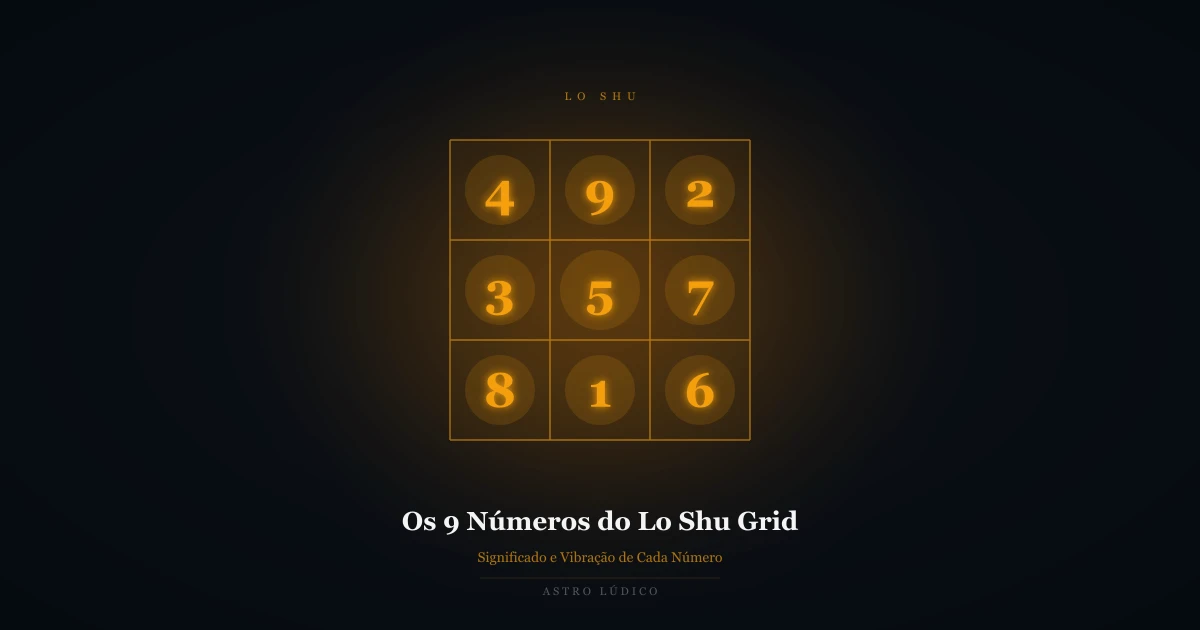
The 9 Numbers of the Lo Shu Grid: Meaning and Vibration
Discover the individual meaning and vibration of each of the 9 numbers in the Lo Shu Grid, how their position shapes the reading, and how their presence or absence can become a reflection prompt.
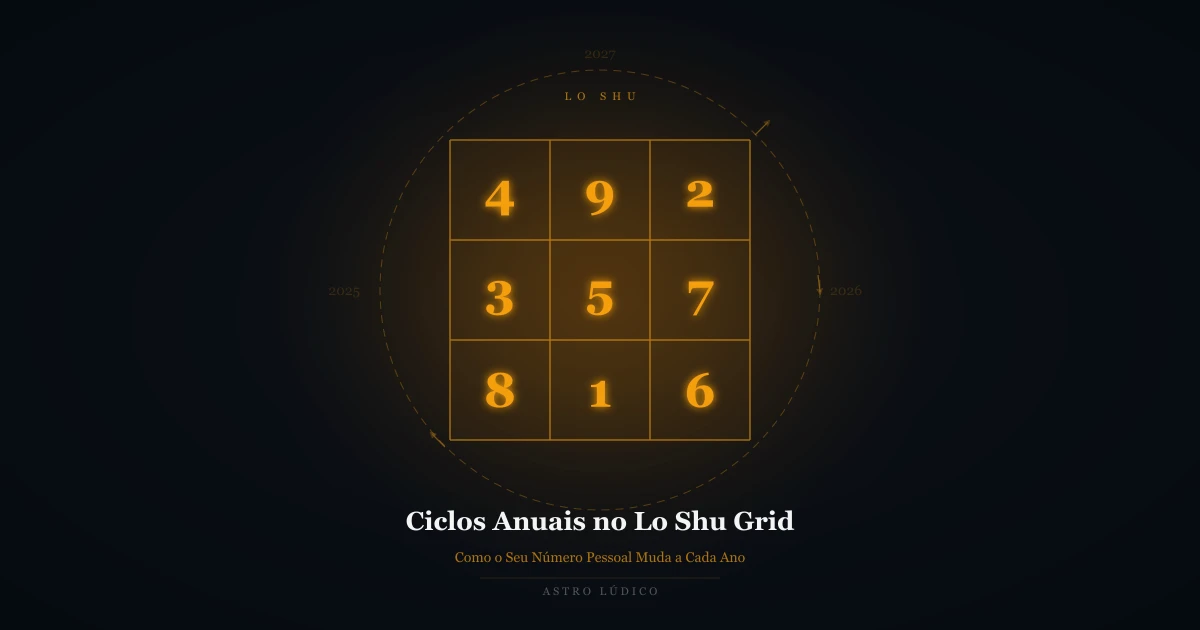
Annual Cycles in the Lo Shu Grid
Discover how your Personal Year Number changes every year and how each of the nine cycles shapes your decisions, relationships, and personal growth.

Tree of Life and Numerology: A Symbolic Guide to the 10 Sefirot
Explore the Tree of Life, the 10 Sefirot and 22 paths as a symbolic tradition, and examine how this project connects those ideas to a numerological map.