On this page
- How to Calculate Your Personal Year Number
- The Nine Years of the Cycle and What Each One Means
- Practical Example: Finding Your Personal Year in 2025
- Using Your Personal Year Number to Make Better Decisions
- Universal Cycles vs. Personal Cycles
- Transitions Between Cycles: What to Expect at the Turning Points
- A method check for Annual Cycles in the Lo Shu Grid
- A question for your next reading
- A second pass through the grid context
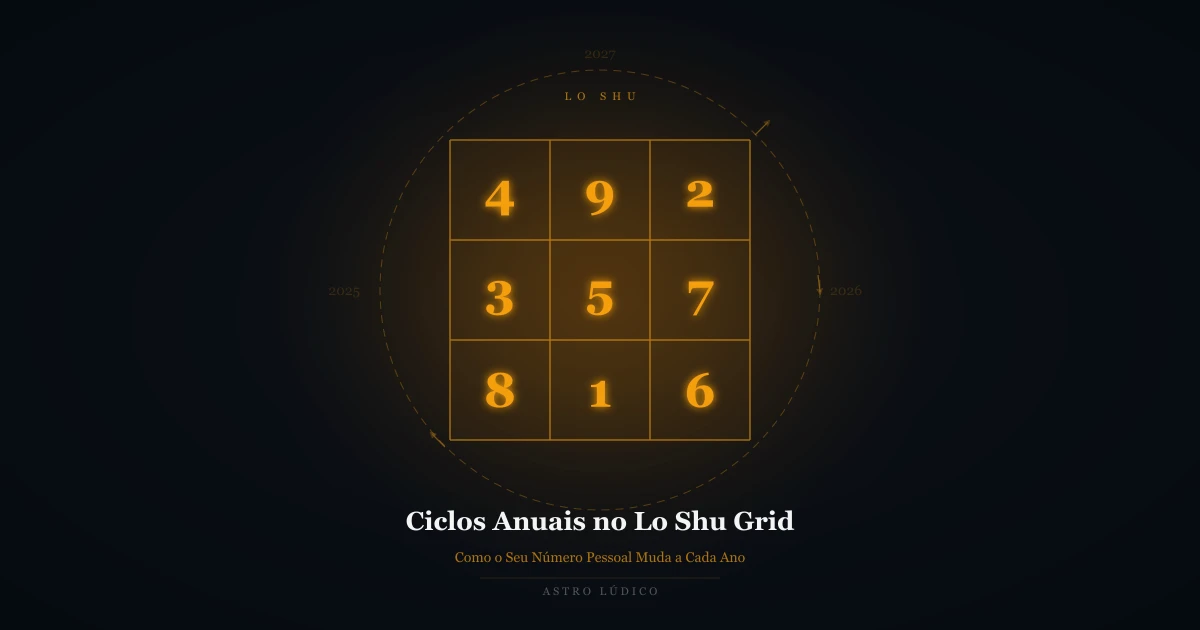
Most people think of the Lo Shu Grid as a fixed portrait of their birth date — a snapshot of the numbers they came in with. But the system has a dynamic dimension that many overlook: every year your personal numerical vibration shifts, opening a new chapter in a nine-year cycle. Understanding these annual cycles transforms the Lo Shu from a static map into a living calendar that can guide your choices with real precision.
How to Calculate Your Personal Year Number
The calculation is straightforward. Take the day and month of your birth, add the four digits of the current year, then reduce the total to a single digit between 1 and 9. For example, if you were born on the 7th of March and the current year is 2025, you add 7 + 3 + 2 + 0 + 2 + 5 = 19, then 1 + 9 = 10, then 1 + 0 = 1. That gives you a Personal Year 1 for 2025. This single number defines the predominant energy available to you throughout the year.
The Nine Years of the Cycle and What Each One Means
Each of the nine years in the Lo Shu cycle carries a distinct quality. Moving through them with awareness helps you work with the natural flow of each period rather than against it.
- Year 1 — New beginnings: This is the year to plant seeds. New projects, directions, and identities take root now. Act boldly; what you start in Year 1 echoes through the next eight years.
- Year 2 — Patience and cooperation: The energy slows down intentionally. Partnerships, negotiations, and emotional bonds are highlighted. Pushing too hard backfires; listening and waiting bring better results.
- Year 3 — Expansion and creativity: Expression comes alive. Art, communication, travel, and social connections flourish. This is one of the lighter years — enjoy it and share your ideas widely.
- Year 4 — Work and foundation: Effort is the theme. Systems, discipline, and practical structures demand your attention. What you build now with patience will stand for years to come.
- Year 5 — Change and freedom: Everything shifts. Unexpected opportunities and disruptions appear. Flexibility and adaptability are your best tools; resist the urge to cling to the familiar.
- Year 6 — Responsibility and healing: Home, family, and relationships move to the foreground. Service, care, and healing are natural themes. It is a year to nurture what already exists.
- Year 7 — Introspection and spirituality: The cycle turns inward. Analysis, solitude, and deeper study are favored. This is a powerful year for personal development and spiritual practice.
- Year 8 — Harvest and material results: Effort from past years now yields tangible rewards. Career, finances, and authority are highlighted. Act with confidence and claim what you have worked for.
- Year 9 — Completion and release: The cycle closes. Old chapters end, and what no longer serves you is ready to go. Gratitude and letting go make space for the fresh Year 1 that follows.
Practical Example: Finding Your Personal Year in 2025
Suppose your birthday is November 14th. Add the day (1 + 4 = 5), the month (1 + 1 = 2), and the year (2 + 0 + 2 + 5 = 9). The partial results total 16, then reduce to 7, so your Personal Year for 2025 is 7. In a traditional reading, Year 7 can provide a prompt for reflection, study, and reviewing priorities, while the following Year 8 can prompt a conversation about resources, responsibility, or accomplishment. These associations do not determine investment timing, expansion, risk, or any financial decision.
Using Your Personal Year Number to Make Better Decisions
Once you know your current year, the number becomes a practical filter for choices. In a Year 4, launching a risky creative venture is swimming against the current; consolidating finances or building a skill base is swimming with it. In a Year 5, locking yourself into rigid five-year plans may feel suffocating because the energy is calling for experimentation. You do not have to let the cycle control you, but aligning your plans with its natural qualities reduces friction and amplifies results.
- Year 1–3: Initiate, expand, and express — ideal for launching new projects and forming connections.
- Year 4–6: Build, stabilize, and nurture — the right moment for long-term commitments and deepening roots.
- Year 7–9: Reflect, harvest, and release — use this phase to integrate lessons and prepare for the next cycle.
Universal Cycles vs. Personal Cycles
Beyond your Personal Year, the calendar year itself carries a Universal Year Number. To find it, simply add the digits of the year: 2025 becomes 2 + 0 + 2 + 5 = 9, making 2025 a Universal Year 9 — a global cycle of endings, release, and preparation for renewal. When your Personal Year and the Universal Year resonate with similar themes, those themes feel especially pronounced. When they contrast — say a personal Year 1 inside a universal Year 9 — you may notice the tension between wanting to begin something new while the collective energy is still clearing old patterns.
Transitions Between Cycles: What to Expect at the Turning Points
The most intense moments in the nine-year cycle often occur at the transitions: the shift from Year 9 into Year 1, from Year 3 into Year 4, and from Year 8 into Year 9. These turning-point years can feel disorienting because the energy of one phase is winding down while the energy of the next has not yet fully arrived. Recognizing these thresholds prevents unnecessary anxiety. A Year 9 that feels like everything is falling apart is often doing exactly what it should — clearing the ground so that Year 1 can plant new seeds on fertile soil.
The Lo Shu cycle is not a script that determines your fate. It is a rhythm you can choose to move with consciously. Knowing your current year gives you context, not limitation. Each number is an invitation to develop a specific set of strengths, and the entire nine-year arc is an opportunity to grow in every direction. By combining your birth chart's fixed numbers with this living annual cycle, the Lo Shu becomes one of the most practical and elegantly simple tools for navigating your life with intention.
A method check for Annual Cycles in the Lo Shu Grid
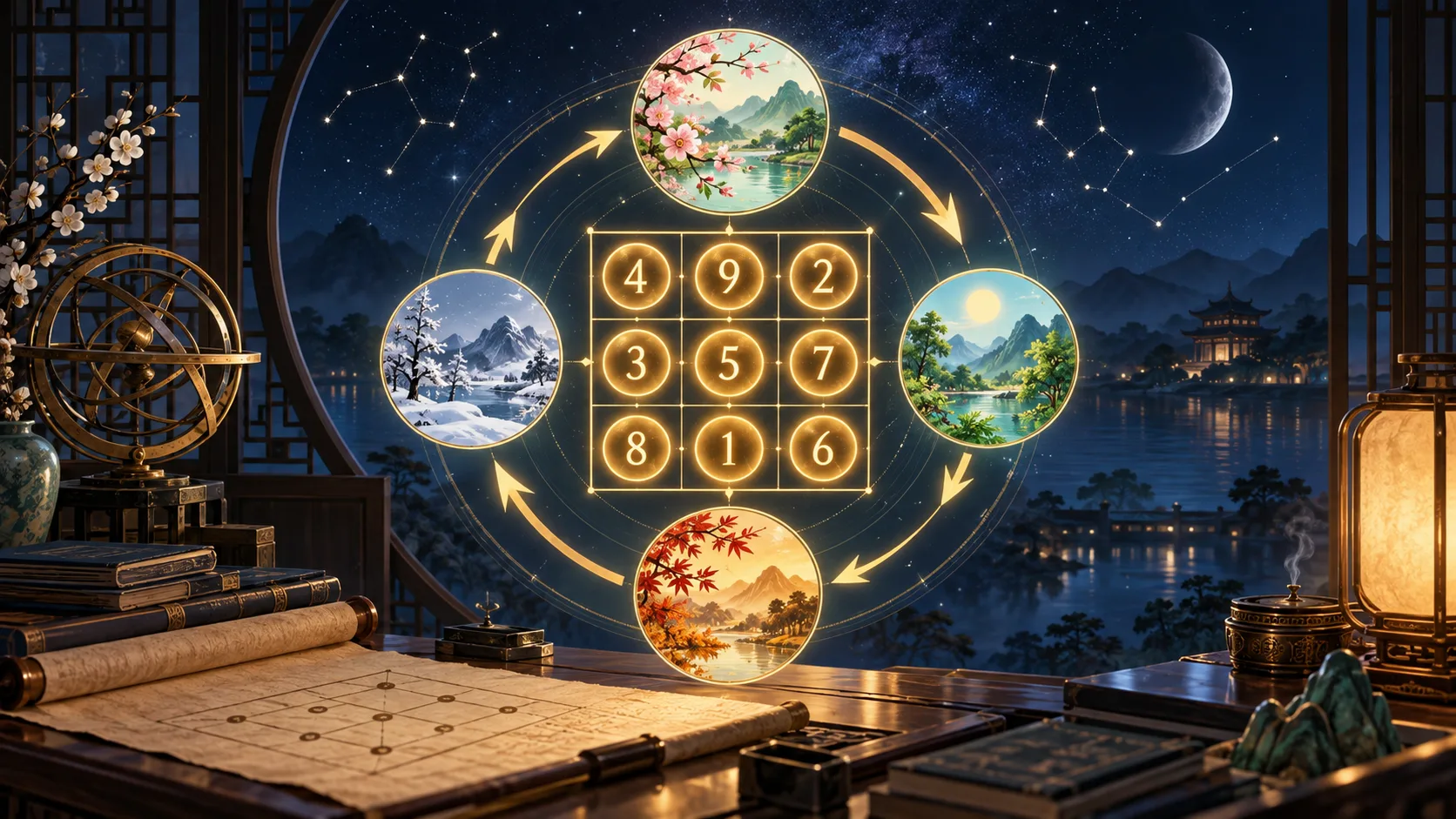
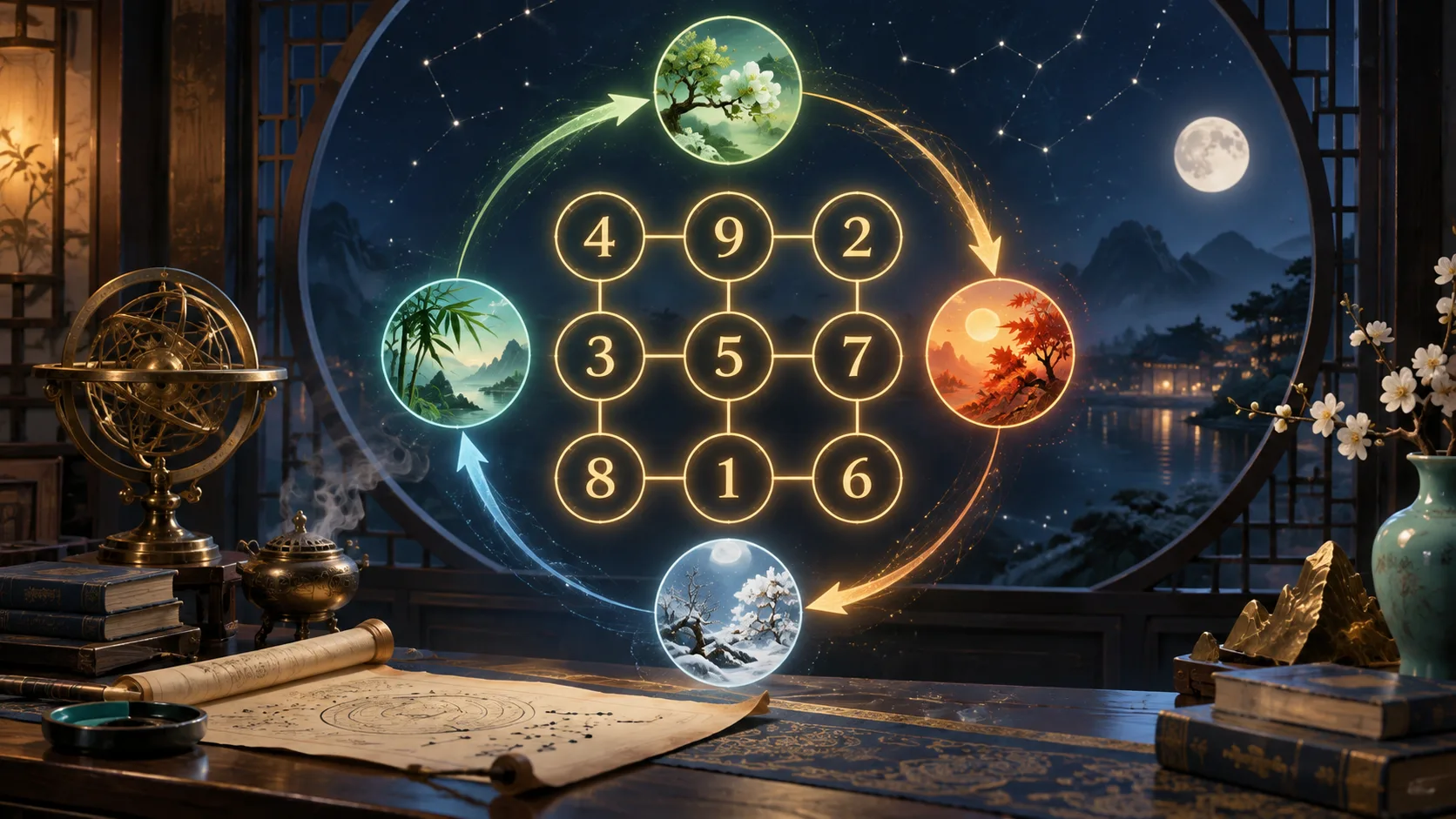
The method becomes more useful when the reader can reproduce it and see where interpretation begins. Start with the fixed 3×3 Lo Shu arrangement, place the date digits according to the project’s rules, and distinguish presence, repetition, absence, and arrows. A grid pattern is meaningful only in relation to the cells that actually contain it. For this article, keep an annual cycle as a window for attention, not an event forecast.
A small example
Mark one cell or arrow, describe what is visible, and write a practical question about habit or attention. The example demonstrates the grid grammar; it does not prove an immutable trait. In “Annual Cycles in the Lo Shu Grid”, write the input and the observed result before choosing a meaning.
Keep the neighbouring concept separate
The Lo Shu Grid is not the Destiny Matrix and not a diagnosis. Five-Element language adds a traditional correspondence, not a measurement of health or character. Keep this distinction explicit while reading “Annual Cycles in the Lo Shu Grid”.
Turn the result into an observation
Keep a short note for “Annual Cycles in the Lo Shu Grid”: the input, the displayed position, one interpretation, and one observation from ordinary life. Revisit it after a few days and allow the observation to change the question. This simple loop protects the reader from treating a first impression as a verdict. Use “Annual Cycles in the Lo Shu Grid” as a prompt, then compare it with one ordinary observation.
A question for your next reading
Which cell or arrow is actually present, what ordinary behaviour could illustrate it, and what information is missing from the grid? If the prompt creates fear, pressure, or a consequential decision, pause and use ordinary evidence and qualified support. For “Annual Cycles in the Lo Shu Grid”, let the next question be about an annual cycle as a window for attention, not an event forecast.
Before closing the reading, check:
- canonical cell placement
- presence and absence described separately
- symbolic prompt checked against habit
Share a Lo Shu reading with care
When you share “Annual Cycles in the Lo Shu Grid”, explain which input and position produced the reading. Point to one observable detail from the article—the cells, repetitions, absences, or arrows actually present—and leave room for another person to disagree. A symbolic result can open a conversation, but it cannot label a partner, promise a financial outcome, or replace qualified advice.
A second pass through the grid context
Return to “Annual Cycles in the Lo Shu Grid” and compare the first impression with the canonical grid, a daily habit, and the limits of the correspondence.
On a second pass through “Annual Cycles in the Lo Shu Grid”, compare the interpretation with the canonical grid, a daily habit, and the limits of the correspondence. If lived evidence points elsewhere, keep the observation and revise the question. That is a more honest use of a symbolic method than forcing the chart to deliver a verdict.
Did this guide help you?
Astro Ludico is an independent project. Your support helps us create more free tools and educational content.
About the Author: Kelwin Felipe
Creator of Astro Lúdico, software developer and independent researcher in Cabalistic Numerology, dedicated to translating ancestral wisdom into practical and intuitive tools for self-knowledge.
Content graph
The pillar guide for this theme
Build the broader context before exploring this focused article.
Lo Shu Grid: Introduction to the 4,000-Year-Old Magic Square
Read first
Helpful foundations
These articles establish the concepts used here.
From study to practice
Put this into practice
Explore the related interactive tool: Lo Shu Grid.
Keep exploring
Related studies
Explore adjacent questions selected for this article.
The Personal Year in Kabbalah: Planning Your 9-Year Cycle
Learn how to calculate your Personal Year and understand which phase of the 9-year cycle you are currently experiencing.
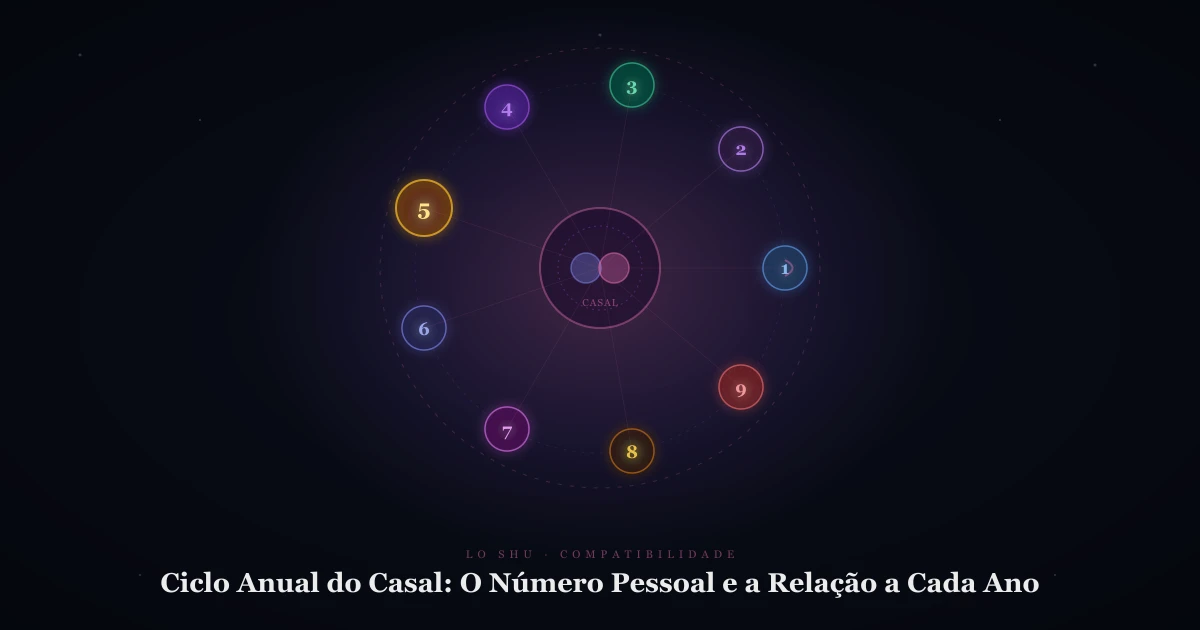
Annual Couple Cycle: How the Personal Number Affects the Relationship Each Year
Discover how the Lo Shu annual cycle interacts with both partners' personal numbers to frame a conversation about the theme of each year in the relationship.
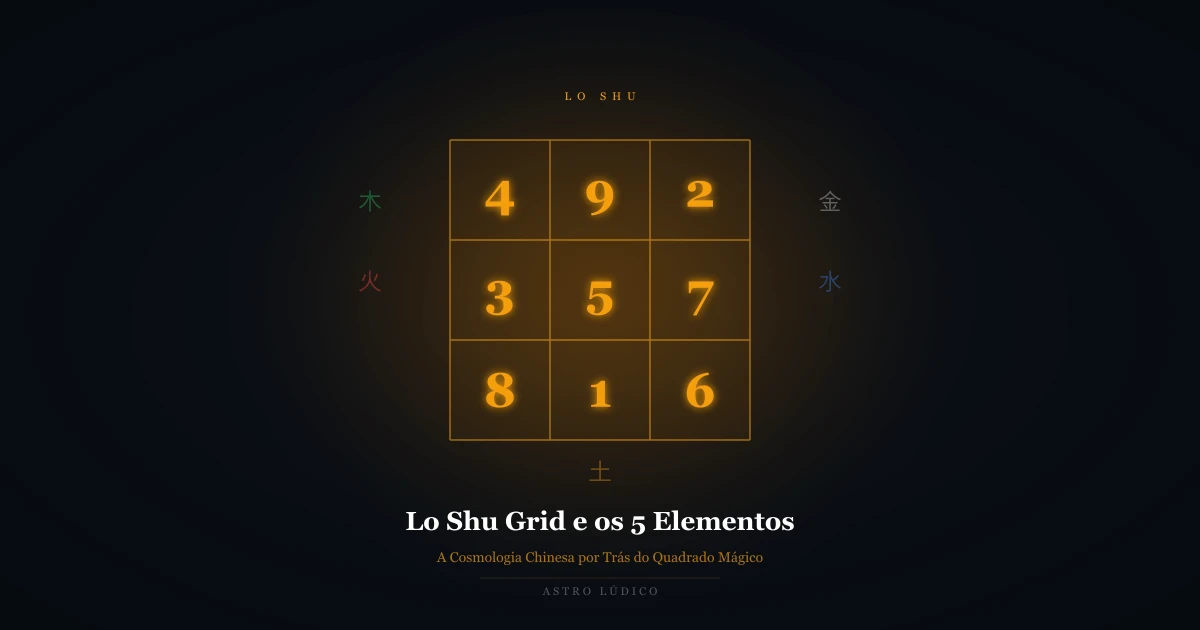
Lo Shu Grid and the Five Elements: How Chinese Cosmology Lives in Your Numbers
Discover how Wood, Fire, Earth, Metal, and Water connect to the nine numbers of the Lo Shu Grid, and learn to read elemental balance and imbalance in your personal map.