On this page
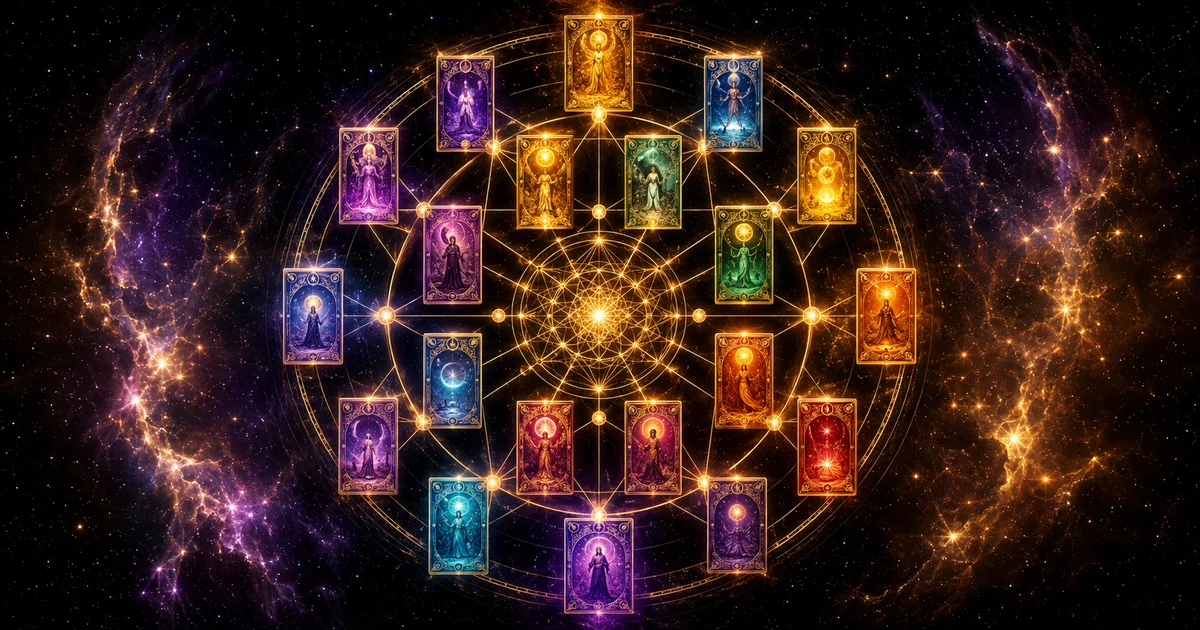
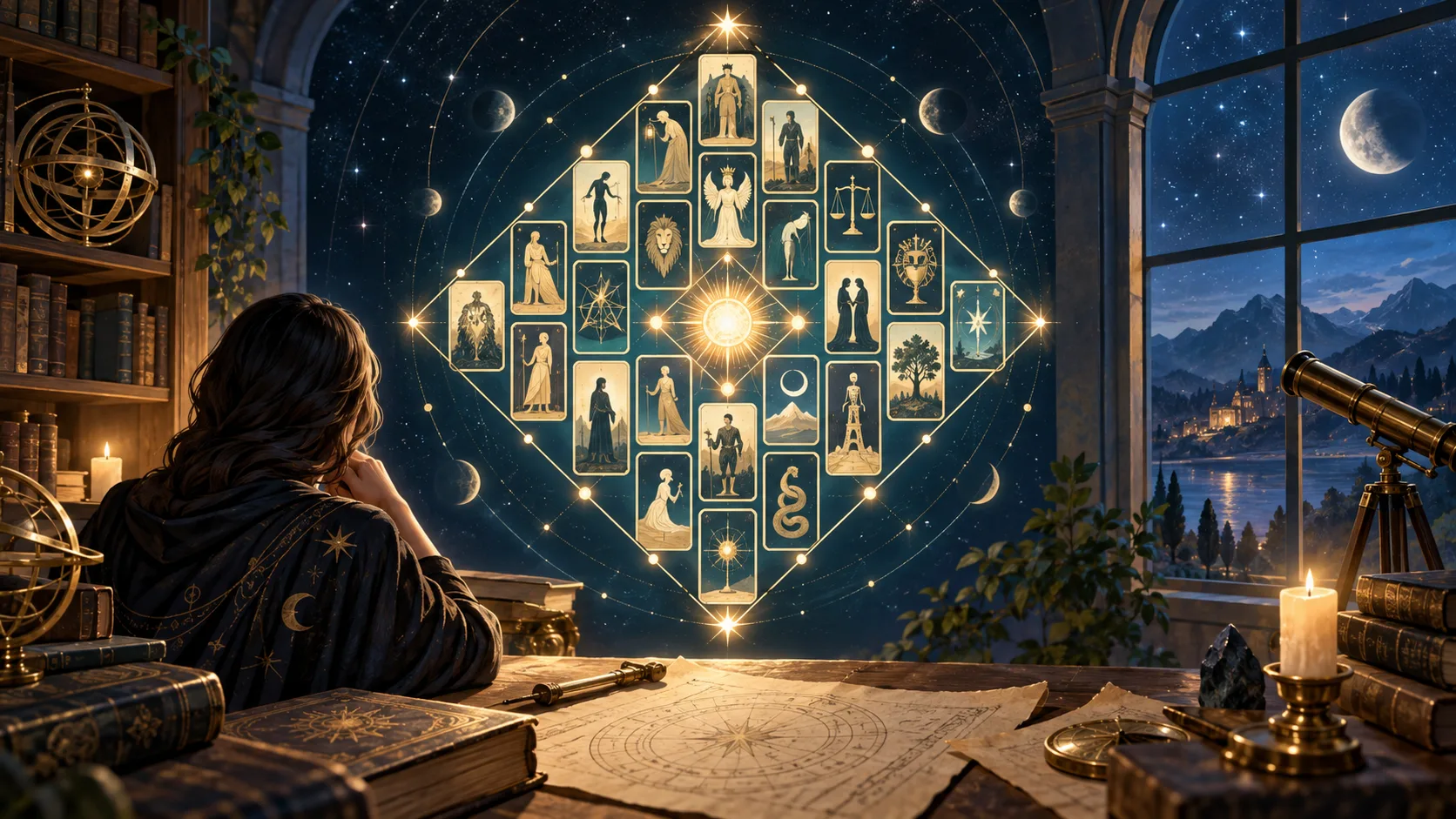
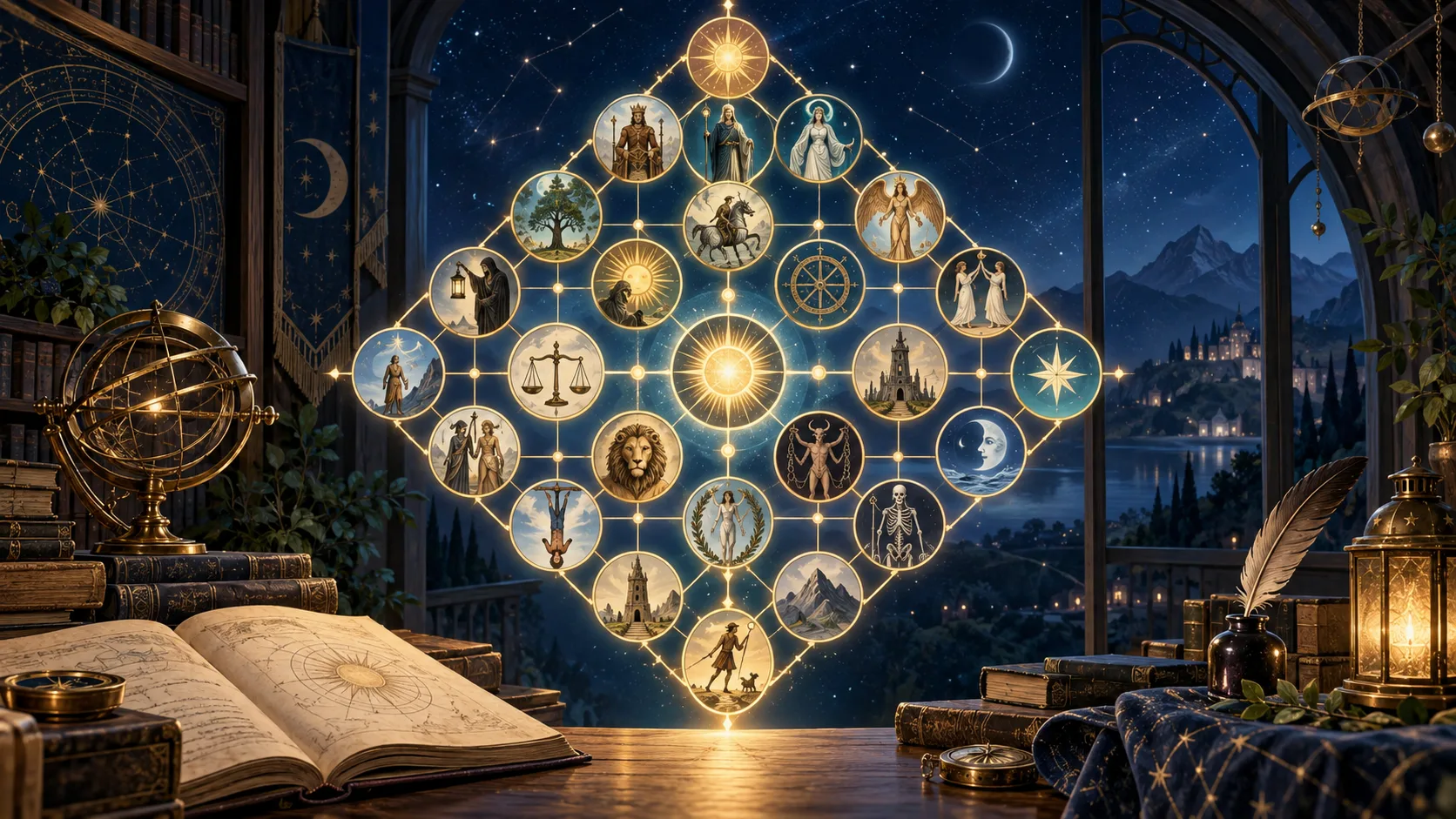
The Destiny Matrix is a symbolic framework that uses a birth date as an input and places 22 Major Arcana in defined positions. Rather than predicting the future, the project uses these images as prompts for discussing patterns, choices, strengths, and difficulties. An Arcana does not define personality, career, relationships, or a past life.
The Core Meaning of Arcanas in the Matrix
Each number in your matrix represents a lesson or an active vibration. In the calculation, any sum of digits exceeding 22 is reduced (for example, 23 becomes 2 + 3 = 5, while 29 becomes 2 + 9 = 11). Let's explore what each of the 22 arcanas represents as a primary archetype on your personal map:
- Arcana 1 (The Magician): The energy of creation, leadership, and willpower. Indicates a person with strong initiative and manifesting power.
- Arcana 2 (The High Priestess): Represents intuition, mystery, and hidden knowledge. Shows sensitivity, wisdom, and a natural ability to read between the lines.
- Arcana 3 (The Empress): The energy of fertility, abundance, beauty, and creation. Deep connection to nature, maternal lineage, and material growth.
- Arcana 4 (The Emperor): Structure, discipline, authority, and power. Associated with organization, stability, and paternal energy.
- Arcana 5 (The Hierophant): The teacher and lawgiver. Represents family values, traditions, learning, and the transmission of knowledge.
- Arcana 6 (The Lovers): Choice, relationships, beauty, and harmony. Highlights the need to make choices from the heart and seek balanced partnerships.
- Arcana 7 (The Chariot): Focus, determination, and victory. Symbolizes clear goals, travel, movement, and overcoming obstacles.
- Arcana 8 (Justice): Law, karma, balance, cause and effect. Teaches the importance of integrity, fairness, and understanding life's lessons.
- Arcana 9 (The Hermit): Solitude, wisdom, inner search, and teaching. Indicates a need for introspection, self-knowledge, and sharing deep insights.
- Arcana 10 (Wheel of Fortune): Luck, cycles, movement, and trusting the flow. Highlights dynamic changes, opportunities, and learning to adapt to life's phases.
- Arcana 11 (Strength): Vital force, potential, physical power, and resilience. Shows the ability to manage passions and face challenges with inner stamina.
- Arcana 12 (The Hanged Man): New perspectives, service, sacrifice, and pause. Teaches the value of seeing things differently and releasing control.
- Arcana 13 (Death): Transformation, endings, release, and profound change. Represents the cycles of birth and rebirth, letting go of what no longer serves.
- Arcana 14 (Temperance): Balance, harmony, patience, and moderation. Shows healing, synthesis of opposites, and finding the middle path.
- Arcana 15 (The Devil): Temptation, passion, materialism, and raw energy. Points to physical desires, charisma, and the challenge of overcoming attachments.
- Arcana 16 (The Tower): Sudden collapse, awakening, and rebuilding. Symbolizes breaking down false structures to build on solid truth.
- Arcana 17 (The Star): Hope, talent, visibility, and inspiration. Indicates creativity, divine protection, and sharing your light with a larger audience.
- Arcana 18 (The Moon): Imagination, fears, shadows, and intuition. Explores the subconscious mind, psychic gifts, and overcoming illusions.
- Arcana 19 (The Sun): Success, joy, leadership, and generosity. The energy of vitality, clarity, public recognition, and positive influence.
- Arcana 20 (Judgement): Rebirth, family karma, and system transformation. Highlights major decisions, awakening, and healing ancestral lines.
- Arcana 21 (The World): Expansion, globalization, freedom, and completeness. Represents broad horizons, international connections, and harmony.
- Arcana 22 (The Fool): Absolute freedom, new beginnings, trust, and innocence. The leap of faith, unbounded potential, and traveling light.
Key Positions and How Arcanas Manifest
An Arcana is interpreted in relation to its position, the calculation used, and the context supplied by the reader. A constructive or difficult expression is a question for observation, not a diagnosis or a command to change one’s life.
1. The Personality Vertex (Left)
This is your calling card. It represents the qualities you project to the world and how others perceive you. If it operates in a positive frequency, you feel confident, aligned, and easily attract opportunities. If negative, you might struggle with the shadow aspects of that specific archetype, feeling misunderstood or acting defensively.
2. The Soul Comfort Zone (Center)
The central node represents your inner essence, the state where your soul feels at peace and recharged. For instance, having Arcana 9 (The Hermit) in the center means you find peace in solitude, self-reflection, and deep wisdom, while Arcana 19 (The Sun) means you recharge through joy, leadership, and social expression.
3. The Karmic Tail (Bottom)
The lower triad is a calculated group of positions in this implementation. Some traditions call it karmic, but the numbers do not prove a past-life event, a debt, or a punishment. Use the triad to examine present patterns and choices, keeping ordinary evidence and personal context in view.
How to Work with Your Arcanas
To work with an Arcana, describe the position and the behaviour that is actually observable before choosing a constructive experiment. The chart can suggest a vocabulary for reflection; it cannot diagnose a person, promise material abundance, or replace communication and qualified support.
Position changes the question
The 22 Arcana are not a list of fixed personality types. In the Matrix, the position gives the symbol a question: a centre position may invite reflection on comfort and integration, while a lineage or relationship position asks about a different field of experience. Start with the calculated position, then consult the Arcana’s constructive and difficult expressions.
A careful example records three things: the Arcana and position, one behaviour that illustrates its constructive side, and one excess that could be noticed without turning it into a diagnosis. This sequence keeps interpretation close to observation and makes it possible to revise the reading when lived evidence does not support it.
Constructive and difficult expressions
“Light” and “shadow” are useful shorthand for possibilities, not moral verdicts. A difficult expression is not a permanent defect, and a constructive expression is not a guarantee. Use both as prompts for an experiment, a conversation, or a boundary, while keeping ordinary evidence and professional support in charge of consequential decisions.
A method check for The 22 Major Arcanas in the Destiny Matrix: A Symbolic Study Guide
The method becomes more useful when the reader can reproduce it and see where interpretation begins. The calculator places one of the 22 Major Arcana in a named position derived from the birth-date method. Read the Arcana through that position first; a keyword copied from a general card list is not yet an interpretation of the chart.
A small example
For one result, write the Arcana’s constructive expression, a possible excess, and one behaviour that would make the distinction visible. The exercise keeps symbolism connected to observation instead of turning it into an identity label.
Keep the neighbouring concept separate
An Arcana is not a diagnosis or a prediction of an event. The same card can invite different questions in a talent, lineage, relationship, or money position.
Turn the result into an observation
Keep a short note for “The 22 Major Arcanas in the Destiny Matrix: A Symbolic Study Guide”: the input, the displayed position, one interpretation, and one observation from ordinary life. Revisit it after a few days and allow the observation to change the question. This simple loop protects the reader from treating a first impression as a verdict.
A question for your next reading
What does this Arcana ask me to notice in this particular position, what would its shadow look like in ordinary behaviour, and what remains unknown? If the prompt creates fear, pressure, or a consequential decision, pause and use ordinary evidence and qualified support.
Before closing the reading, check:
- Arcana and position named together
- constructive and difficult expressions separated
- behaviour observed before conclusion
Share an Arcana reading with care
When you share “The 22 Major Arcanas in the Destiny Matrix: A Symbolic Study Guide”, explain which input and position produced the reading. Point to one observable detail from the article—the Arcana together with its named position—and leave room for another person to disagree. A symbolic result can open a conversation, but it cannot label a partner, promise a financial outcome, or replace qualified advice.
A second pass through the Arcana context
Return to “The 22 Major Arcanas in the Destiny Matrix: A Symbolic Study Guide” and compare the first impression with the Arcana, its position, and the behaviour you can actually observe.
On a second pass through “The 22 Major Arcanas in the Destiny Matrix: A Symbolic Study Guide”, compare the interpretation with the Arcana, its position, and the behaviour you can actually observe. If lived evidence points elsewhere, keep the observation and revise the question. That is a more honest use of a symbolic method than forcing the chart to deliver a verdict.
Did this guide help you?
Astro Ludico is an independent project. Your support helps us create more free tools and educational content.
About the Author: Kelwin Felipe
Creator of Astro Lúdico, software developer and independent researcher in Cabalistic Numerology, dedicated to translating ancestral wisdom into practical and intuitive tools for self-knowledge.
Content graph
The pillar guide for this theme
Build the broader context before exploring this focused article.
Destiny Matrix Complete Guide: Structure, Positions, Arcana, and Interpretation
Read first
Helpful foundations
These articles establish the concepts used here.
From study to practice
Put this into practice
Explore the related interactive tool: Destiny Matrix.
Continue the path
Next in this study path
Move forward through the sequence selected by the editorial graph.

Keep exploring
Related studies
Explore adjacent questions selected for this article.
The Portrait and The Center: How the World Sees You and Your Essence
Understand the difference between your Portrait (day of birth) and your Center (comfort zone) in the Destiny Matrix.
The Karmic Tail in the Destiny Matrix: A Symbolic Reading of Recurrent Patterns
Learn how the lower triad is calculated in the Destiny Matrix and how to use it as a symbolic prompt for reflecting on recurring patterns—without treating it as proof of past lives or a method of healing.
How to Interpret Your Destiny Matrix: A Step-by-Step Guide
A beginner-friendly guide to reading your Destiny Matrix mandala, understanding what each vertex means, and deciphering your personal path.