
On this page
- Reading the two anchors together
- Position changes the question
- A comparison you can repeat
- From symbol to observation
- Continue with the matrix
- What the position contributes
- A second reading with evidence
- Read the coordinates before the keywords
- A worked comparison without a personal verdict
- A practical two-column reading
- When another article is the better source
- When the same Arcana appears twice
- A note that keeps the context visible
- A question that can be checked
- Portrait and Center beside the rest of the map
- If the reading changes over time
- A short reading you can share
Reading the two anchors together
The Portrait is position A, the left vertex derived from the birth day. The Center is position E, calculated as the central point of the primary matrix geometry. They answer different questions: A describes the interface through which the chart is encountered; E describes the point that organizes the person’s sense of coherence in this system.
The same Arcana can therefore appear in both places without being redundant. A 5 at Portrait would invite questions about how rules, teaching or convention are presented in social contact. A 5 at Center would invite questions about which form of order or meaning helps the person feel oriented. The symbol supplies a vocabulary; the position supplies the grammar.
A small hypothetical example
Imagine a chart with A=5 and E=22. The example does not diagnose its owner. It simply shows why context matters: the public presentation can be read through structure and recognizable principles, while the central position can be explored through openness, experimentation and the need for room to change. If A and E were both 5, the repeated theme would still have two jobs rather than one duplicated label.
The result renderer may expose light, shadow, essence or potential fields from the interpretation catalog. Use those as contrasting ways a symbol may be expressed, not as permanent personality facts. Read the field attached to the position, then compare it with the rest of the mandala before forming a synthesis.
Try it in the calculator
Generate a matrix, locate A and E, write the two values down, and describe each position in one sentence before consulting the interpretation. The useful output is a better question about context and choice, not a prediction.
The Destiny Matrix is an educational symbolic framework. It does not establish a medical, financial, legal or relationship outcome, and it cannot replace informed judgment.


Position changes the question
A number is not a complete interpretation by itself. Compare A and E as two locations: ask what is visible in contact with other people, what supports inner coherence, and where the two viewpoints agree or differ. The comparison is useful precisely because it leaves room for context instead of assigning one permanent social mask or essence.
A comparison you can repeat
Write the value shown at A, then the value shown at E, and note the position label before consulting the Arcana text. If the same Arcana appears twice, keep two separate notes. This small discipline prevents a familiar keyword from replacing the geometry that gives the result its meaning.
From symbol to observation
Use the hypothetical A=5 and E=22 only as a reading exercise: describe one observable situation in which structure is helpful and another in which openness is helpful. Do not turn the example into a verdict about a person. A real chart still needs the person’s experience to test or challenge the question.
Continue with the matrix
After recording Portrait and Center, return to the calculator and compare them with the other positions rather than isolating one label. Astro Lúdico offers an educational symbolic framework for reflection; it does not establish a fixed personality, diagnosis, or life outcome.
What the position contributes
Portrait and Center should be read after the date-based result and the central geometry have been identified. The first tells you which location is being discussed; the Arcana supplies the symbolic vocabulary. Keeping those two layers separate makes it possible to compare the same Arcana in another position without treating the chart as a personality test.
A second reading with evidence
Return to the notes after a week and add one concrete observation for A and one for E. If neither observation fits, revise the question instead of forcing the symbol to fit. This small check turns the matrix into an iterative reflection and keeps the calculator, the text and lived experience in dialogue.
Read the coordinates before the keywords
In the canonical diagram, Portrait A is the left-most point and Center E is the middle point. The letter identifies a position; the number identifies the Arcana displayed there. A useful note therefore records both, such as “A = 5” or “E = 22”, before borrowing any symbolic vocabulary. This prevents the meaning of an Arcana from being detached from the place where the calculator found it.
The two positions answer different questions. A can prompt observation about the way a person enters a social situation, while E can prompt observation about the conditions that feel familiar or steady. These are interpretive questions, not fixed traits, and neither position proves what someone is like in every context.
A worked comparison without a personal verdict
Take the hypothetical pair A = 5 and E = 22. The example does not claim that any real person has this pair. It simply lets the reader compare two Arcana in two locations: first describe what the position contributes, then note where the two descriptions reinforce one another or create a question. The calculation supplies the pair; the reader supplies observations from lived context.
If the same Arcana appeared at A and E, the repetition would still not make the positions interchangeable. Record the repeated number, the two coordinates and the situation in which each reading was useful. A position-sensitive note is more informative than a list of keywords because it can be checked later against concrete experience.
A practical two-column reading
Create two columns labelled A and E. In the first, write one observable situation involving presentation, first contact or social adaptation. In the second, write one situation involving comfort, recovery or an internal point of reference. Add a third line for uncertainty: what would you need to observe before accepting or revising the interpretation?
This format also reveals when an attractive keyword is doing too much work. If an interpretation cannot be connected to a position, an input or an observation, treat it as a loose association rather than as a result of the Matrix. The calculator remains reproducible even when a symbolic reading stays open-ended.
When another article is the better source
Portrait and Center describe two anchors, not every line of the mandala. Questions about money, relationships, lineage or yearly cycles belong to their own channels and calculations. Linking to those articles keeps this page focused and helps readers avoid asking one pair of positions to explain the whole chart.
Use the interactive Matrix to confirm the displayed coordinates, then return here to record what A and E invite you to examine. The most responsible conclusion is usually a more precise question, not a permanent identity statement.
When the same Arcana appears twice
A repeated number is not a duplicate answer. If the same Arcana is shown at A and E, keep the two notes separate: one describes the position through which the person meets the world, while the other describes the center used for inner orientation. The repetition may be interesting because the same symbolic vocabulary is active in two places, but the location still determines the question. A number never becomes a complete reading simply because it appears more than once.
A note that keeps the context visible
- Write the coordinate first: Portrait A or Center E.
- Copy the displayed Arcana and the calculation input that produced it.
- Describe one ordinary situation that made the position relevant.
- Add one constructive possibility and one limit, without ranking the person.
This small format is more useful than a long list of adjectives. It lets you return to the same chart later and see whether the interpretation clarified an experience or merely sounded attractive. If the two positions seem to contradict each other, do not choose a winner. Describe the setting in which each one appears and allow the difference to remain information.
A question that can be checked
Try a question such as: “Where do I adapt my presentation to a group, and what helps me feel at home when the group is gone?” The first half gives the Portrait a concrete context; the second gives the Center a concrete context. The answer can change with age, work, culture and relationships. That flexibility is not a failure of the Matrix. It is the reason the result works better as a reflective map than as a fixed identity statement.
Portrait and Center beside the rest of the map
A reader can lose the thread by treating A and E as the whole Matrix. They are two anchors, not a summary of every channel. Once the two notes are made, look at the nearby positions and ask whether they support, complicate or simply sit beside the first impression and the comfort-zone question. This wider view is especially important when an Arcana feels uncomfortable. Another position may show a resource, a relationship or a cycle that changes how the same symbol is experienced. The right conclusion is often a more precise question, not a stronger adjective.
If the reading changes over time
The displayed values do not need to change for a person’s relationship with them to change. A new workplace can make a social presentation more visible; a period of rest can change what feels like comfort; a conversation can reveal that a familiar interpretation was borrowed from someone else. Keep the original calculation and date of the note, then add the new observation. This preserves a record of learning without claiming that the number itself caused the change.
A short reading you can share
If you are reading someone else’s chart, begin by asking whether they want a symbolic reflection and which setting matters to them. Share the coordinate and the question before sharing a keyword. “Your A is 5” is information; “How do you experience structure when meeting a new group?” is an invitation. This order protects consent and leaves the other person free to correct the context. A good Portrait and Center reading should make a conversation more precise, never make the reader feel observed without permission.
Did this guide help you?
Astro Ludico is an independent project. Your support helps us create more free tools and educational content.

About the Author: Kelwin Felipe
Creator of Astro Lúdico, software developer and independent researcher in Cabalistic Numerology, dedicated to translating ancestral wisdom into practical and intuitive tools for self-knowledge.
Content graph
The pillar guide for this theme
Build the broader context before exploring this focused article.
Destiny Matrix Complete Guide: Structure, Positions, Arcana, and Interpretation
Read first
Helpful foundations
These articles establish the concepts used here.
From study to practice
Put this into practice
Explore the related interactive tool: Destiny Matrix.
Continue the path
Next in this study path
Move forward through the sequence selected by the editorial graph.
The Karmic Tail in the Destiny Matrix: A Symbolic Reading of Recurrent Patterns
Learn how the lower triad is calculated in the Destiny Matrix and how to use it as a symbolic prompt for reflecting on recurring patterns—without treating it as proof of past lives or a method of healing.

What Is the Money Channel in the Destiny Matrix?
Learn where the five Money Channel positions appear in the Destiny Matrix, what C, Q, M, N and L mean in Astro Lúdico’s current tool, and why the channel differs from the Abundance Obstacle.
Keep exploring
Related studies
Explore adjacent questions selected for this article.
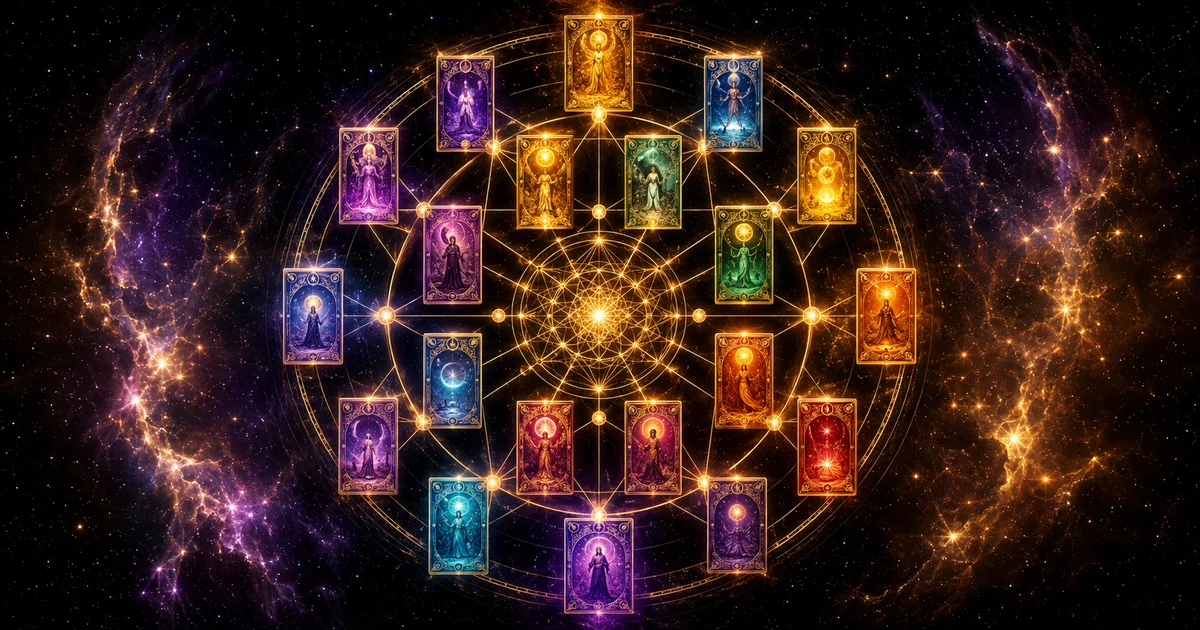
The 22 Major Arcanas in the Destiny Matrix: A Symbolic Study Guide
Study how the 22 Major Arcanas are used as symbolic archetypes in the Destiny Matrix, with attention to position, context, choice, and limits.

The 3 Life Phases of Purpose in the Destiny Matrix
Explore how your development themes can be revisited through the Material, Spiritual, and Divine purposes across different ages.
How to Interpret Your Destiny Matrix: A Step-by-Step Guide
A beginner-friendly guide to reading your Destiny Matrix mandala, understanding what each vertex means, and deciphering your personal path.