
On this page
- The Destiny Matrix Was Created by Natalia Ladini
- Two Schools of Compatibility Calculation
- Why the Numbers Can Differ: A Conceptual Example
- Why We Chose the Union of Baggage Method
- What This Means for Your Reading
- A Note of Gratitude
- A method check for Why Destiny Matrix Compatibility Results Vary Between Calculators
- A question for your next reading
- A second pass through the relationship context
If you have ever compared your Destiny Matrix compatibility result between two different websites and noticed different numbers — especially in positions like the Karmic Tail, Talents, or the inner channels — you are asking exactly the right question. And the answer is not a bug. It is a methodological difference.
This article exists thanks to a thoughtful question raised by u/daniiscutee (https://www.reddit.com/user/daniiscutee/), who noticed a discrepancy between our tool and another calculator and took the time to share it privately. Questions like this make the community stronger and help us be more transparent about how our system works.
The Destiny Matrix Was Created by Natalia Ladini
Before we explain the math, it is important to understand the origin. The Destiny Matrix is a numerological system created by Natalia Ladini, a Ukrainian researcher and author who developed the method in the early 2000s. She is the source of the octagram structure, the 22-arcana framework, and the rules for how individual matrices are calculated and interpreted. Our calculator is built directly on her original method.
Two Schools of Compatibility Calculation
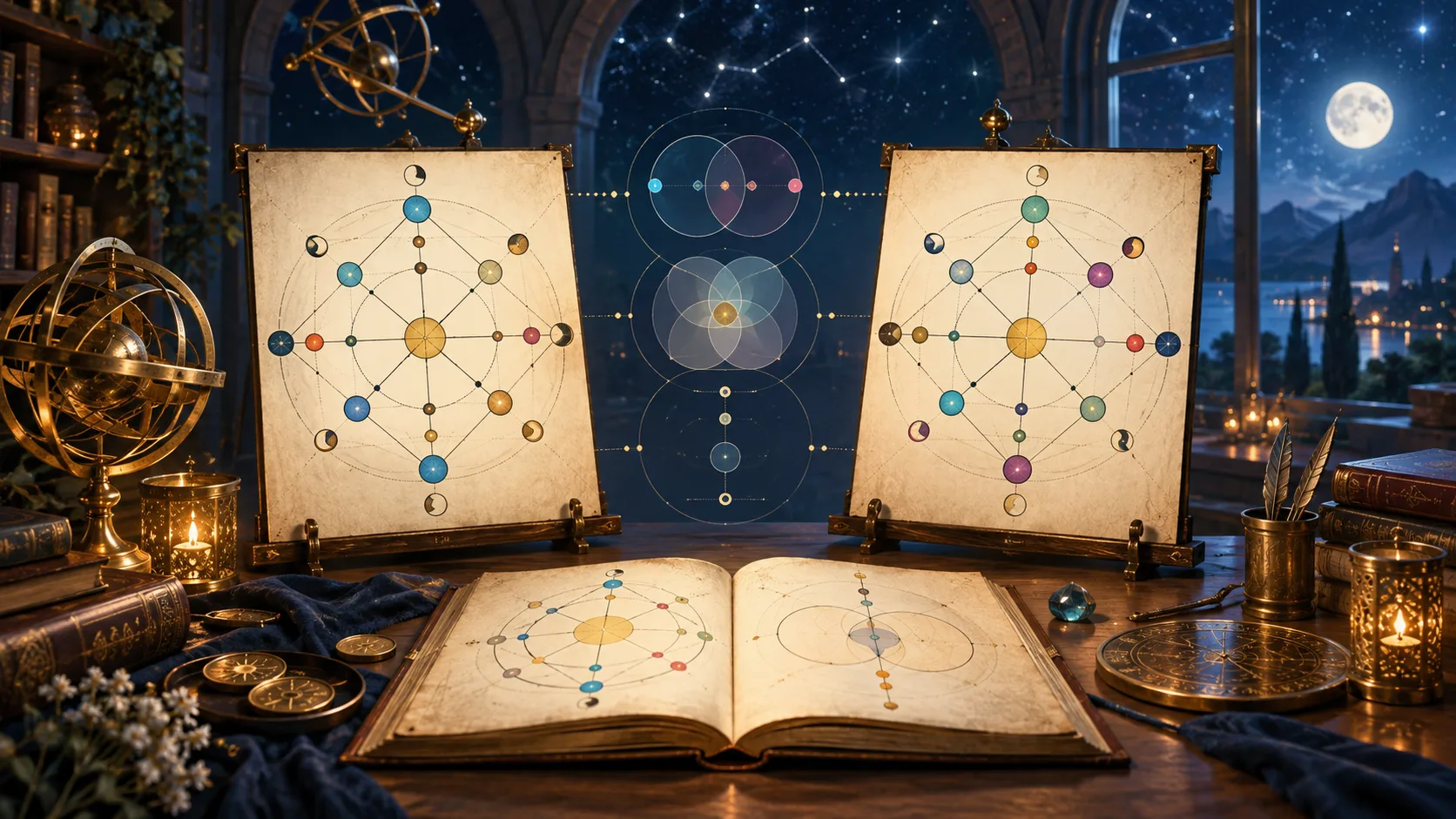
When two individual matrices are combined into a compatibility chart, there are two main approaches used by different calculators. Both are mathematically valid, but they reflect fundamentally different philosophies about what a relationship represents.
Approach 1: Union of Baggage (The Method We Use)
In this approach, which follows Natalia Ladini's original teaching, the compatibility chart is built by directly combining each equivalent point of both individual matrices. Person A's Karmic Tail point is added to Person B's Karmic Tail point. Person A's Love entry point is added to Person B's Love entry point. And so on, for every position across the entire structure.
The philosophy behind this method is clear: a relationship does not erase the individual. Each person brings their own karmic history, their own unresolved patterns, and their own gifts into the union. The compatibility chart, in this view, is the actual encounter of those two energetic worlds. The Karmic Tail of the couple is literally the sum of what both people are carrying. Nothing is discarded.
Approach 2: Third Entity Recalculation (Used by Some Other Calculators)
In this approach, only the five cardinal points of each person (Day, Month, Year, Base, and Center) are summed together. These five merged values are then used as the seed for a brand-new matrix, which is recalculated from scratch using the same formulas as a solo individual matrix. The relationship is treated as a new person being born.
The idea here is poetic: the couple creates a third entity that did not exist before. However, because the remaining positions — including the Karmic Tail, Talents, and inner channels — are recalculated from these five merged seeds rather than from the original individual points, the results can differ significantly from the Union of Baggage approach, even when starting from the same two birth dates.

Why the Numbers Can Differ: A Conceptual Example
Imagine two people, Person A and Person B. Each has their own Karmic Tail sequence derived from their individual birth date. In our method, the couple's Karmic Tail is calculated as follows:
- Karmic Tail Tip (Union) = Tip of Person A + Tip of Person B → reduced to 1–22
- Karmic Tail Mid (Union) = Mid of Person A + Mid of Person B → reduced to 1–22
- Karmic Tail Base (Union) = Base of Person A + Base of Person B → reduced to 1–22
In the recalculation method, the process works differently. The Base of the Union is computed first by summing only the Base points of both people. The Center of the Union is computed by summing only the Center points. Then, the Karmic Tail Tip is derived as Base_Union + Center_Union — a completely different calculation chain that can produce a different number, even though the two birth dates are identical.
This is not an error on either side. It is simply a different equation producing a different result, rooted in a different belief about what compatibility means.
Why We Chose the Union of Baggage Method
Our calculator follows the Union of Baggage approach because we believe it is more faithful to the spirit of the Destiny Matrix as Natalia Ladini conceived it. The system was designed to reveal the karmic layers each person carries — not to dissolve them into an abstraction. When you are reading a couple's compatibility, the question is not only what energy they create together, but what each person brings to the table and how those energies interact at every level.
If one person carries a karmic lesson in a specific position, and another person also carries a lesson in the same position, the Union of Baggage approach preserves that shared theme in the relationship chart because it is genuinely present in both individuals. The recalculation method may produce a different number for that position, not because the theme disappeared, but because the math chain started from a different input.
What This Means for Your Reading
If you have compared results from our tool with another calculator and found differences in the internal positions — such as the Karmic Tail, the Talent line, or the inner triangle — this explanation is the reason. The five cardinal points of the union (the main structure of the mandala) are typically consistent across both methods, since they are computed the same way. It is the derived positions where the two approaches diverge.
Neither result is wrong. But they are not interchangeable. Choosing between them means choosing a philosophy of what the relationship chart is meant to show. For us, it shows the actual encounter of two individual histories — which is why we stay with the method that Natalia Ladini developed.
A Note of Gratitude
This article was directly inspired by u/daniiscutee (https://www.reddit.com/user/daniiscutee/), who noticed the difference and reached out with genuine curiosity rather than assuming an error. That kind of engaged and thoughtful feedback is exactly what helps a tool like this grow. Thank you — your question prompted us to be clearer about something that deserves to be explained publicly, not just in a private message.
A method check for Why Destiny Matrix Compatibility Results Vary Between Calculators
The method becomes more useful when the reader can reproduce it and see where interpretation begins. When calculators disagree, compare the implementation contract before comparing spiritual explanations: inputs, reduction, position labels, Arcana table, and display order. A reproducible method is more useful than a claim that one website has the only valid answer.
A small example
Use the same public date pair in two tools and make a difference log. Mark each changed input or rule, then describe which output this project has chosen and why a reader should not merge both outputs silently.
Keep the neighbouring concept separate
Method variation is not evidence that the people in the relationship have different destinies. It means the reader is looking at different conventions and should name the convention before interpreting it.
Turn the result into an observation
Keep a short note for “Why Destiny Matrix Compatibility Results Vary Between Calculators”: the input, the displayed position, one interpretation, and one observation from ordinary life. Revisit it after a few days and allow the observation to change the question. This simple loop protects the reader from treating a first impression as a verdict.
A question for your next reading
Which exact rule explains the difference, can I reproduce the project result, and have I told the reader where the method stops and interpretation begins? If the prompt creates fear, pressure, or a consequential decision, pause and use ordinary evidence and qualified support.
Before closing the reading, check:
- input normalization
- reduction and position contract
- difference log kept with the reading
Share a compatibility reading with care
When you share “Why Destiny Matrix Compatibility Results Vary Between Calculators”, explain which input and position produced the reading. Point to one observable detail from the article—a specific interaction, agreement, or boundary—and leave room for another person to disagree. A symbolic result can open a conversation, but it cannot label a partner, promise a financial outcome, or replace qualified advice.
A second pass through the relationship context
Return to “Why Destiny Matrix Compatibility Results Vary Between Calculators” and compare the first impression with the shared position, the conversation, and each person’s autonomy.
On a second pass through “Why Destiny Matrix Compatibility Results Vary Between Calculators”, compare the interpretation with the shared position, the conversation, and each person’s autonomy. If lived evidence points elsewhere, keep the observation and revise the question. That is a more honest use of a symbolic method than forcing the chart to deliver a verdict.
Did this guide help you?
Astro Ludico is an independent project. Your support helps us create more free tools and educational content.

About the Author: Kelwin Felipe
Creator of Astro Lúdico, software developer and independent researcher in Cabalistic Numerology, dedicated to translating ancestral wisdom into practical and intuitive tools for self-knowledge.
Content graph
The pillar guide for this theme
Build the broader context before exploring this focused article.
How the Destiny Compatibility Matrix Works: A Complete Overview
Read first
Helpful foundations
These articles establish the concepts used here.
From study to practice
Put this into practice
Explore the related interactive tool: Compatibility Matrix.
Methodology
How to read this material responsibly
This article is connected to the Natalia Ladini compatibility method reference.
Read the methodologyContinue the path
Next in this study path
Move forward through the sequence selected by the editorial graph.
Keep exploring
Related studies
Explore adjacent questions selected for this article.

Compatibility Matrix: A Symbolic Guide to Reading Relationships
Learn how the Compatibility Matrix compares two symbolic maps, highlights themes for reflection, and supports conversations without predicting a relationship's outcome.

How the Destiny Compatibility Matrix Works: A Complete Overview
Discover the mechanics behind the Destiny Compatibility Matrix: how two birth dates combine to form a shared energetic field and what each zone can help you examine.

Most Common Compatibility Matrix Mistakes
Avoid the most common mistakes people make when reading a Compatibility Matrix. Learn how to interpret shared energy accurately and get the most from your result.