On this page
- The Idea of Purpose in the Matrix
- Where Purpose Appears in the Mandala
- Themes the reading can organize
- Purpose Is Not a Sentence
- How to Use This Information Day-to-Day
- From a purpose label to a shared question
- A method check for Relationship Themes in the Compatibility Matrix: A Reflective Guide
- A question for your next reading
- A second pass through the relationship context
This article uses the phrase relationship purpose as a name for a reflective question, not as a fact encoded in two birth dates. A compatibility map can help partners discuss recurring themes, expectations, and choices; it cannot prove why two souls met or decide whether a relationship should continue.
The Idea of Purpose in the Matrix
Within the symbolic tradition behind the Destiny Matrix, readers may interpret a relationship as a context for growth or learning. The map can organize themes associated with the selected Arcana, but any meaning must be tested against present evidence, consent, communication, and the choices of the people involved.
Where Purpose Appears in the Mandala
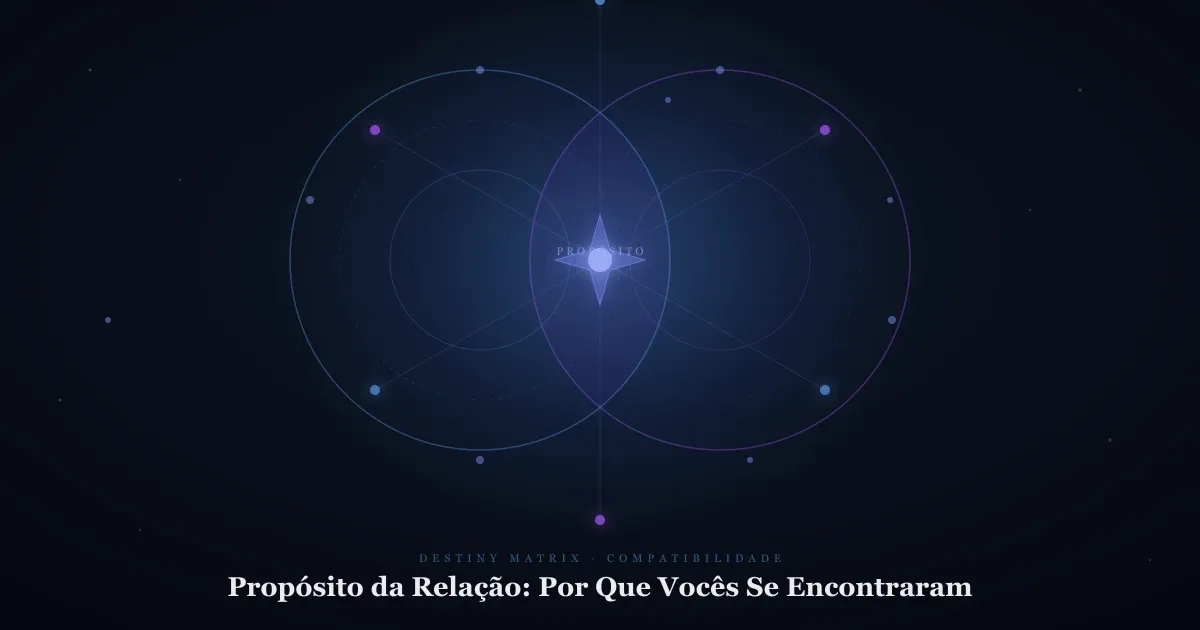
In the Compatibility Matrix, the relationship's purpose is mainly visible in the Sky Line — the spiritual axis of the mandala — and in the center of the shared mandala. The center represents the core of the relationship: what it is, in essence, beyond roles and external circumstances.
Themes the reading can organize
Repair and care as reflection themes
Some readers use supportive Arcana as prompts to discuss repair, trust, boundaries, or support. They do not prove that a partner can heal another person, diagnose a wound, or replace qualified care.
Shared projects and values
Some pairs may use the compatibility map to discuss shared projects, values, or responsibilities. The Arcana can frame a conversation; it cannot assign a mission or guarantee that a project will succeed.
Change and challenge as reflection themes
Some relationships feel challenging or changeable, and a reader may use the symbols to examine expectations, boundaries, and choices. An intense pattern does not prove karmic causation or require anyone to stay in an unsafe relationship.
Purpose Is Not a Sentence
Knowing the purpose of a relationship is not knowing its fate. An intense relationship may bring difficult questions, but the symbols do not decide whether it is healthy or destructive. Any sense of relief or change depends on communication, consent, and concrete choices — not on a promise of healing.
How to Use This Information Day-to-Day
- When tensions arise, ask: what lesson is this moment trying to teach?
- Identify recurring themes — they are clues to the energetic purpose.
- Use the reading as a starting point for honest conversations with your partner.
- Remember that the purpose of a relationship can evolve over time.
The Compatibility Matrix invites us to see each relationship not as a fixed destiny, but as a living field of learning. Using “purpose” as a reflective question does not eliminate challenges. It can help partners choose a more careful conversation, while any growth remains contingent on concrete actions and support.
From a purpose label to a shared question
A compatibility position can organize a conversation about what two people are learning, building, or negotiating together. It cannot establish why they met, guarantee permanence, or turn a difficult relationship into a required lesson. Read the position after checking the calculation and the shared chart, then translate its language into a question both people can answer.
For example, a theme of structure can become a discussion about plans, responsibilities, and flexibility. A theme of change can become a review of how each person handles uncertainty. The useful evidence is the conversation and the repeated behaviour, not the symbolic label by itself.
Safety before symbolism
No compatibility reading overrides consent, privacy, financial independence, or physical and emotional safety. If a relationship includes coercion, threats, stalking, or abuse, seek appropriate support instead of treating the chart as a reason to stay or endure. The matrix is a reflective aid, never an obligation.
A method check for Relationship Themes in the Compatibility Matrix: A Reflective Guide
The method becomes more useful when the reader can reproduce it and see where interpretation begins. Treat relationship purpose as a theme suggested by the shared chart, not as an explanation of why two people were fated to meet. Start with the displayed shared positions and translate them into questions about agreements, learning, support, or friction.
A small example
A shared Arcana can become one neutral prompt: “Where do we need clearer expectations?” Record the answer each person gives and compare it with a real interaction rather than with an idealized story about the relationship.
Keep the neighbouring concept separate
Purpose is not a contract to stay, forgive, rescue, or tolerate harm. A symbolic theme cannot override consent, safety, autonomy, or the option to leave a relationship.
Turn the result into an observation
Keep a short note for “Relationship Themes in the Compatibility Matrix: A Reflective Guide”: the input, the displayed position, one interpretation, and one observation from ordinary life. Revisit it after a few days and allow the observation to change the question. This simple loop protects the reader from treating a first impression as a verdict.


A question for your next reading
What shared practice would make the proposed theme observable for a week, and what sign would tell us to seek help beyond a symbolic reading? If the prompt creates fear, pressure, or a consequential decision, pause and use ordinary evidence and qualified support.
Before closing the reading, check:
- theme rather than fate
- one shared practice
- safety and autonomy protected
Share a compatibility reading with care
When you share “Relationship Themes in the Compatibility Matrix: A Reflective Guide”, explain which input and position produced the reading. Point to one observable detail from the article—a specific interaction, agreement, or boundary—and leave room for another person to disagree. A symbolic result can open a conversation, but it cannot label a partner, promise a financial outcome, or replace qualified advice.
A second pass through the relationship context
Return to “Relationship Themes in the Compatibility Matrix: A Reflective Guide” and compare the first impression with the shared position, the conversation, and each person’s autonomy.
On a second pass through “Relationship Themes in the Compatibility Matrix: A Reflective Guide”, compare the interpretation with the shared position, the conversation, and each person’s autonomy. If lived evidence points elsewhere, keep the observation and revise the question. That is a more honest use of a symbolic method than forcing the chart to deliver a verdict.
Did this guide help you?
Astro Ludico is an independent project. Your support helps us create more free tools and educational content.
About the Author: Kelwin Felipe
Creator of Astro Lúdico, software developer and independent researcher in Cabalistic Numerology, dedicated to translating ancestral wisdom into practical and intuitive tools for self-knowledge.
Content graph
The pillar guide for this theme
Build the broader context before exploring this focused article.
How the Destiny Compatibility Matrix Works: A Complete Overview
Read first
Helpful foundations
These articles establish the concepts used here.
From study to practice
Put this into practice
Explore the related interactive tool: Compatibility Matrix.
Continue the path
Next in this study path
Move forward through the sequence selected by the editorial graph.
Keep exploring
Related studies
Explore adjacent questions selected for this article.

Love Channel in the Compatibility Matrix: A Symbolic Guide to Affective Patterns
Learn how the Love Channel is calculated in the Destiny Compatibility Matrix and use its themes to discuss attraction, affection, communication, and boundaries without predicting a relationship.
Types of Relationships in the Compatibility Matrix: Love, Friendship, Family, and Business
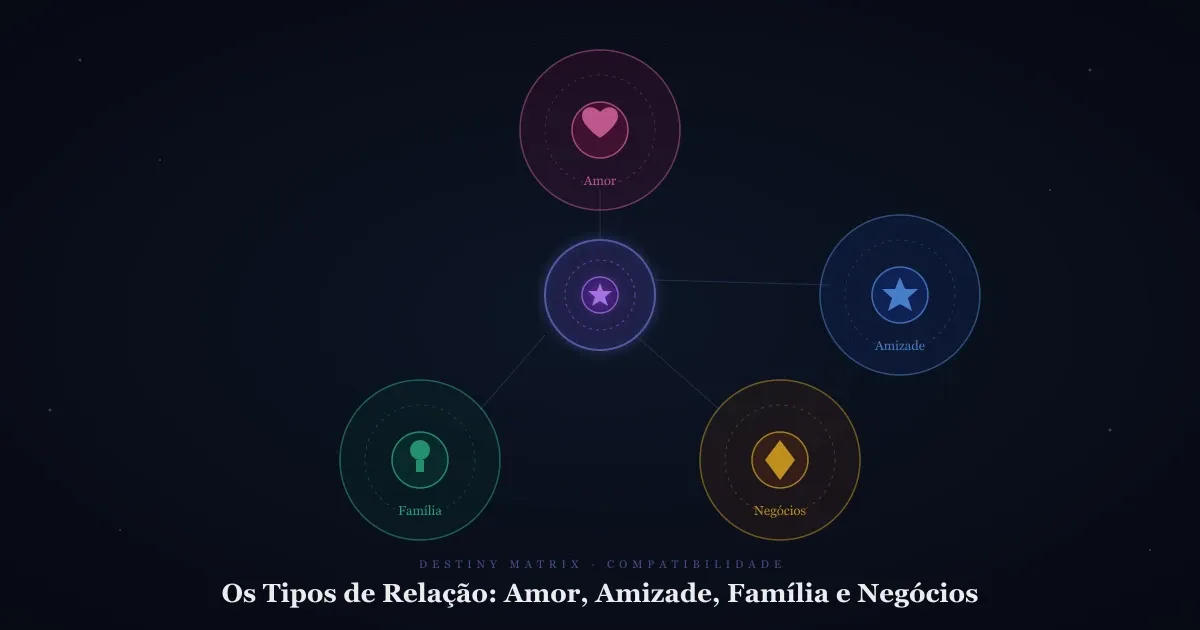
Learn how the Destiny Compatibility Matrix reads different types of relationships — romantic, friendly, family, and professional — and what each can help you discuss about the energetic dynamic.

Compatibility Matrix: A Symbolic Guide to Reading Relationships
Learn how the Compatibility Matrix compares two symbolic maps, highlights themes for reflection, and supports conversations without predicting a relationship's outcome.