On this page
- What Karmas Are in the Compatibility Matrix
- How to Identify Challenges in the Mandala
- The Most Common Patterns
- How to Work with the Relationship's Karmas
- When Karmas Are Not Resolvable
- Naming a pattern without assigning blame
- A method check for Challenges and Karmas in Compatibility: Turning Tensions into Growth
- A question for your next reading
- A second pass through the relationship context
In every significant relationship, there are patterns that repeat — arguments that always return to the same point, feelings of impasse that seem impossible to resolve, or a paradoxical attraction that mixes love and conflict. In the Destiny Compatibility Matrix, these patterns are not seen as flaws in the relationship, but as material to work with: themes that readers may choose to examine together
What Karmas Are in the Compatibility Matrix
Karma, in this context, does not mean punishment — it means unresolved pattern. In the compatibility mandala, karmas appear as arcana in tension positions: points where the energies of the two maps conflict or where a recurring theme calls for conscious attention. They can frame questions about recurring knots in the relationship.
How to Identify Challenges in the Mandala
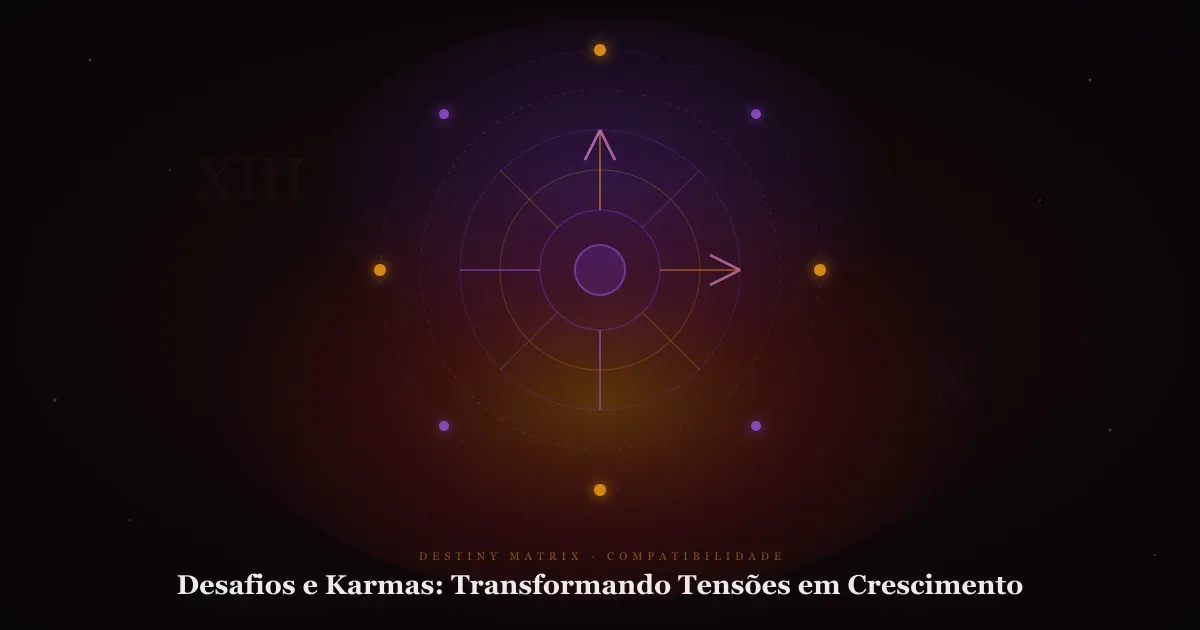
Challenges in the Compatibility Matrix usually appear in specific positions: the karmic axis of the mandala, the relationship's entry portals, and the tension points between the Earth and Sky lines. Arcana like The Devil (XV), The Tower (XVI), Death (XIII), or The Moon (XVIII) in these positions can be read as prompts to notice where the relationship may feel more friction.
The Most Common Patterns
The Control and Dependency Pattern
Frequently represented by The Devil (XV), this pattern can invite a conversation about seeking reassurance or completeness through another person. A person may describe the relationship as intense or possessive. A practical question is how to support autonomy while respecting intimacy.
The Rupture and Renewal Pattern
The Tower (XVI) is traditionally associated with sudden change. Readers may use the image to discuss structures that no longer serve and how to avoid repeating a pattern after disruption; it does not predict a crisis.
The Idealization and Disillusionment Pattern
The Moon (XVIII) in a challenge position can invite reflection on idealization and disappointment. A practical question is how to check assumptions with honest, compassionate communication.
How to Work with the Relationship's Karmas
- Name the pattern without judgment: 'whenever X happens, we tend to do Y.'
- Identify which unmet need is behind the conflict.
- Ask: how do I contribute to this pattern? What can I change in myself?
- Seek resources — therapy, symbolic reading, contemplative practices.
- Celebrate each small change in the pattern as a collective victory.
When Karmas Are Not Resolvable
A symbolic reading cannot determine that a relationship carries a heavy karma or that closure is required. If a pattern feels entrenched, use communication, safety checks, and qualified support to decide what is workable.
Karmic language can change the question from “Why is this happening?” to “What can I observe and choose now?”. It does not remove pain or guarantee growth; concrete support and action still matter.
Naming a pattern without assigning blame
In this method, “karma” is a name for a recurring relational pattern, not a punishment assigned to either person. The responsible sequence is to identify the displayed position, describe the interaction in ordinary language, and ask what could be changed or protected. A symbol may help people notice a pattern; it cannot prove that one partner caused it or deserves it.
A tension associated with control, rupture, or idealization can be tested through a small observation: what happened, what each person assumed, and what boundary or request was missing? Recording the exchange keeps the reading grounded and makes it possible to distinguish a useful prompt from a story that excuses harm.
When a pattern needs outside support
Repeated fear, coercion, threats, financial control, or violence is not a karmic assignment to solve alone. The appropriate next step may be a therapist, mediator, trusted support network, or emergency service. The Compatibility Matrix can frame a question, but real-world safety and qualified help take priority.
A method check for Challenges and Karmas in Compatibility: Turning Tensions into Growth
The method becomes more useful when the reader can reproduce it and see where interpretation begins. Keep the two birth-date inputs separate long enough to understand each individual chart, then identify the shared positions the compatibility tool actually renders. A relationship reading is a comparison of symbols, not a score that can rank a person or guarantee a result. For this article, keep a tension as a recurring pattern, never as a verdict about either partner.
A small example
Choose one shared position, describe the two values, and write one possible conversation each value could invite. The example is useful when it leads to a question about behaviour; it is not proof that the relationship must continue or end. In “Challenges and Karmas in Compatibility: Turning Tensions into Growth”, write the input and the observed result before choosing a meaning.
Keep the neighbouring concept separate
Compatibility is not the same as an individual Destiny Matrix. It adds a relational context, but it cannot replace consent, communication, safety, or professional support when those are needed. Keep this distinction explicit while reading “Challenges and Karmas in Compatibility: Turning Tensions into Growth”.
Turn the result into an observation
Keep a short note for “Challenges and Karmas in Compatibility: Turning Tensions into Growth”: the input, the displayed position, one interpretation, and one observation from ordinary life. Revisit it after a few days and allow the observation to change the question. This simple loop protects the reader from treating a first impression as a verdict. Use “Challenges and Karmas in Compatibility: Turning Tensions into Growth” as a prompt, then compare it with one ordinary observation.


A question for your next reading
Which shared position is visible, what behaviour could make its constructive side observable, and what boundary keeps the interpretation from becoming a verdict about another person? If the prompt creates fear, pressure, or a consequential decision, pause and use ordinary evidence and qualified support. For “Challenges and Karmas in Compatibility: Turning Tensions into Growth”, let the next question be about a tension as a recurring pattern, never as a verdict about either partner.
Before closing the reading, check:
- both inputs and tool version
- shared position named
- conversation or boundary stated
Share a compatibility reading with care
When you share “Challenges and Karmas in Compatibility: Turning Tensions into Growth”, explain which input and position produced the reading. Point to one observable detail from the article—a specific interaction, agreement, or boundary—and leave room for another person to disagree. A symbolic result can open a conversation, but it cannot label a partner, promise a financial outcome, or replace qualified advice.
A second pass through the relationship context
Return to “Challenges and Karmas in Compatibility: Turning Tensions into Growth” and compare the first impression with the shared position, the conversation, and each person’s autonomy.
On a second pass through “Challenges and Karmas in Compatibility: Turning Tensions into Growth”, compare the interpretation with the shared position, the conversation, and each person’s autonomy. If lived evidence points elsewhere, keep the observation and revise the question. That is a more honest use of a symbolic method than forcing the chart to deliver a verdict.
Did this guide help you?
Astro Ludico is an independent project. Your support helps us create more free tools and educational content.
About the Author: Kelwin Felipe
Creator of Astro Lúdico, software developer and independent researcher in Cabalistic Numerology, dedicated to translating ancestral wisdom into practical and intuitive tools for self-knowledge.
Content graph
The pillar guide for this theme
Build the broader context before exploring this focused article.
How the Destiny Compatibility Matrix Works: A Complete Overview
Read first
Helpful foundations
These articles establish the concepts used here.
From study to practice
Put this into practice
Explore the related interactive tool: Compatibility Matrix.
Continue the path
Next in this study path
Move forward through the sequence selected by the editorial graph.
Keep exploring
Related studies
Explore adjacent questions selected for this article.

Love Channel in the Compatibility Matrix: A Symbolic Guide to Affective Patterns
Learn how the Love Channel is calculated in the Destiny Compatibility Matrix and use its themes to discuss attraction, affection, communication, and boundaries without predicting a relationship.
Relationship Themes in the Compatibility Matrix: A Reflective Guide
Explore how the Destiny Compatibility Matrix can organize themes for reflection in a relationship without claiming a fixed purpose, fate, or lesson.

Most Common Compatibility Matrix Mistakes
Avoid the most common mistakes people make when reading a Compatibility Matrix. Learn how to interpret shared energy accurately and get the most from your result.