On this page
- Historical Origins
- Letter-to-Number Conversion Methods
- Scale of Vibration and Reductions
- O Role of Master Numbers
- Focus of Interpretation: Personality vs. Soul Path
- Practical Applications in Daily Life
- Which System Should You Use?
- A method check for Cabalistic vs. Pythagorean Numerology: Key Differences Explained
- A question for your next reading
- A second pass through the number context
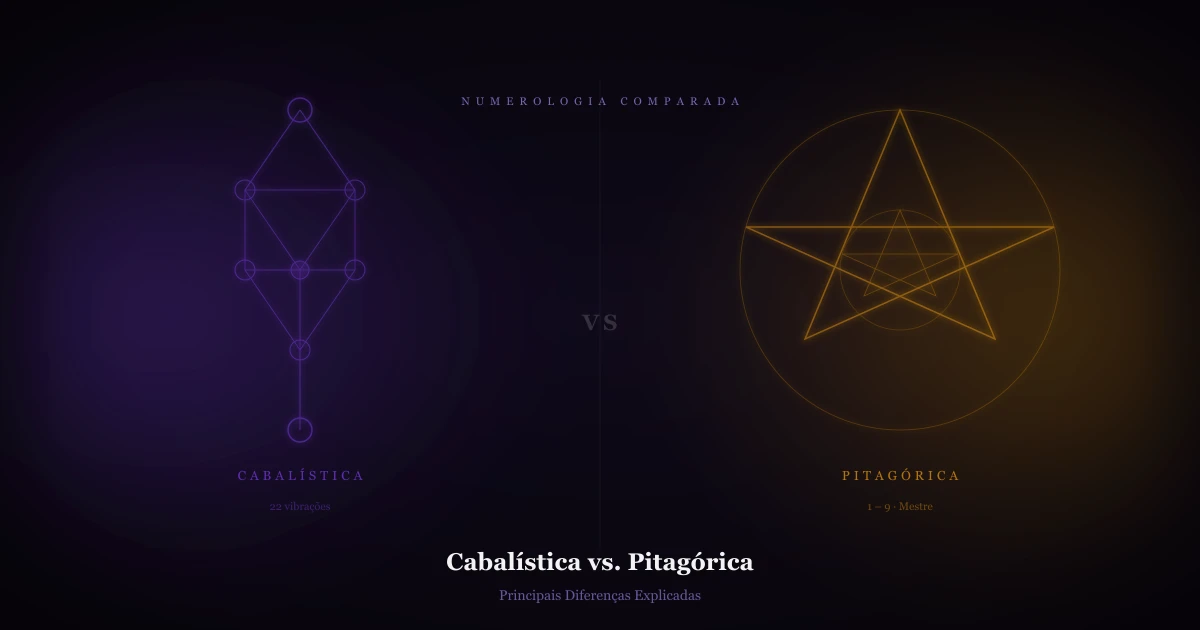
Numerology is the study of symbolic interpretations of numbers and their place in cultural traditions. While many systems exist, two dominate the western world: Pythagorean Numerology and Cabalistic Numerology. Both can be used as lenses for self-reflection, but they stem from different historical origins, use distinct calculation methods, and serve different purposes. Let's explore the key differences between these two systems.
Historical Origins
The roots of these systems shape their philosophical approaches and their ultimate view of the relationship between humanity and the cosmos:
- Pythagorean Numerology: Developed by the ancient Greek mathematician and philosopher Pythagoras in the 6th century BCE. He believed that numbers were the building blocks of the universe and could explain the structure of the physical and psychological realms.
- Cabalistic Numerology: Derived from Kabbalistic wisdom, specifically the Kabbalah, and dating back thousands of years. It is rooted in Gematria, the practice of assigning numerical values to Letter Vibrations to uncover hidden meanings in sacred texts and map the soul's relationship with the divine.
Letter-to-Number Conversion Methods
One of the most practical differences lies in how names are translated into numbers. Pythagorean numerology uses a simple, sequential 1-to-9 grid based on the Latin alphabet (A=1, B=2 ... I=9, J=1 ...). It is highly standardized and direct. For example, the name 'JOHN' converts as J=1, O=6, H=8, N=5 (sum = 20 -> 2).
To understand this phonetical calculation, let's look at the name 'JOHN'. In Pythagorean numerology, the letters correspond directly to their alphabetical positions: J is 1, O is 6, H is 8, N is 5. Summing these values gives 1+6+8+5 = 20, which reduces to 2. The Pythagorean vibration of JOHN is therefore 2 (cooperation, diplomacy, support). In Cabalistic numerology, the phonetic value of J is 1, O is 7, H is 5, N is 5. Summing these values gives 1+7+5+5 = 18, which reduces to 9 (humanitarianism, completion, teaching). The different values show how the two systems capture different layers of the same name: the Pythagorean system evaluates the logical structure of the letters, while the Cabalistic system applies a different phonetic convention to the vocalized sound.
Cabalistic numerology, however, maps Latin letters to Kabbalistic vibrational equivalents, using a grid based on the numbers 1 to 8 (number 9 is considered sacred and separated in the conversion grid). The values correspond to phonetic vibrations rather than alphabetical order. Using the same example, 'JOHN' has different phonetic correspondences that can yield a completely different vibration. This system captures the vibrational frequency of how a name is spoken rather than just written.
Scale of Vibration and Reductions
In the Pythagorean system, all numbers are ultimately reduced to single digits from 1 to 9, with the exception of the Master Numbers (11, 22, and sometimes 33). These numbers represent core personality archetypes.
In Cabalistic Numerology, calculations use 22 distinct vibrations, used in this tradition to organize a range from 1 to 22. This allows for a wider spectrum of interpretations, capturing more nuance in how recurring themes and interpretive categories can be compared. It recognizes that a 12 is not just a reduced 3, but carries its own distinct symbolic associations.
O Role of Master Numbers
Another significant difference lies in how Master Numbers are treated. In Pythagorean numerology, the numbers 11, 22, and 33 are highly significant and are not reduced to single digits. They are traditionally associated with themes of intensity, responsibility, and sustained attention; they do not classify a person or prove a higher calling. In Cabalistic Numerology, while Master Numbers are recognized, all double-digit calculations from 10 to 22 are evaluated as unique vibrations corresponding to the Letter Vibrations, rather than being reduced immediately. This means that a Cabalistic analysis treats a 12 or a 20 with its own set of symbolic associations, without reducing them to 3 or 2, providing a much more granular view of an interpretive map.
Focus of Interpretation: Personality vs. Soul Path
Pythagorean numerology is highly practical and psychological. It acts as an excellent tool for understanding your outward behavior, career strengths, social expression, and personality traits. It is easy to learn and apply, making it perfect for self-development and career guidance.
Cabalistic numerology belongs to a spiritual and karmic interpretive tradition. It organizes themes such as lessons, blockages, and past-life language as symbolic questions; it does not establish a soul’s destiny or a biography across lifetimes.
Practical Applications in Daily Life
In practice, professionals often use these systems for different types of consultations. Pythagorean numerology is widely applied in business (for choosing brand names, product launch dates, or evaluating partnership compatibility) and in career counseling, because of its structured, psychological clarity. Cabalistic numerology may be chosen for spiritual reflection or name experiments, but changing letters cannot be presented as a way to prevent a karmic debt or guarantee a better life path. Choosing which system to use depends entirely on the questions you are asking of the numbers.
Which System Should You Use?
Neither system is superior; they are complementary. If you are looking for practical guidance about your character, career fits, and behavioral patterns, the Pythagorean system is an excellent starting point. If you want to compare spiritual or karmic themes, Cabalistic Numerology offers a different interpretive vocabulary. Using both systems can broaden a reflective comparison; neither one provides a verified account of personality, crisis, or an eternal soul path.
A method check for Cabalistic vs. Pythagorean Numerology: Key Differences Explained
The method becomes more useful when the reader can reproduce it and see where interpretation begins. Compare the two systems by holding the input constant and changing only the convention being studied. Note the range, reduction rule, labels, and interpretive tradition before deciding that one result is more accurate.
A small example
Run one neutral birth-date example through both descriptions and place the outputs in two columns. The exercise shows how labels and reductions shape the reading; it cannot establish which philosophy is universally true.
Keep the neighbouring concept separate
A difference between systems is a difference of method, not evidence that a person has changed. Use each system for the question it actually supports, and do not combine keywords into a new formula without documenting the choice.
Turn the result into an observation
Keep a short note for “Cabalistic vs. Pythagorean Numerology: Key Differences Explained”: the input, the displayed position, one interpretation, and one observation from ordinary life. Revisit it after a few days and allow the observation to change the question. This simple loop protects the reader from treating a first impression as a verdict.


A question for your next reading
Which system answers the question I have, what rule produced each value, and what would I learn by leaving the other system out for this reading? If the prompt creates fear, pressure, or a consequential decision, pause and use ordinary evidence and qualified support.
Before closing the reading, check:
- same input in both systems
- rules compared before meanings
- one question chosen for the reading
Share a numerology reading with care
When you share “Cabalistic vs. Pythagorean Numerology: Key Differences Explained”, explain which input and position produced the reading. Point to one observable detail from the article—the exact name or date input and one observable choice—and leave room for another person to disagree. A symbolic result can open a conversation, but it cannot label a partner, promise a financial outcome, or replace qualified advice.
A second pass through the number context
Return to “Cabalistic vs. Pythagorean Numerology: Key Differences Explained” and compare the first impression with the input, the reduction rule, and what the person actually experiences.
On a second pass through “Cabalistic vs. Pythagorean Numerology: Key Differences Explained”, compare the interpretation with the input, the reduction rule, and what the person actually experiences. If lived evidence points elsewhere, keep the observation and revise the question. That is a more honest use of a symbolic method than forcing the chart to deliver a verdict.
Did this guide help you?
Astro Ludico is an independent project. Your support helps us create more free tools and educational content.

About the Author: Kelwin Felipe
Creator of Astro Lúdico, software developer and independent researcher in Cabalistic Numerology, dedicated to translating ancestral wisdom into practical and intuitive tools for self-knowledge.
Content graph
The pillar guide for this theme
Build the broader context before exploring this focused article.
Cabalistic Numerology: A Complete Guide to the Soul's Numerical Map
Read first
Helpful foundations
These articles establish the concepts used here.
From study to practice
Put this into practice
Explore the related interactive tool: Cabalistic Numerology.
Keep exploring
Related studies
Explore adjacent questions selected for this article.

Destiny Matrix vs Cabalistic Numerology: Key Differences and When to Use Each
Compare Destiny Matrix and Cabalistic Numerology side by side. One maps arcana archetypes from your birth date; the other reads name vibration and core number calculations.

Tree of Life and Numerology: A Symbolic Guide to the 10 Sefirot
Explore the Tree of Life, the 10 Sefirot and 22 paths as a symbolic tradition, and examine how this project connects those ideas to a numerological map.

Name Vibration in Numerology: A Symbolic Guide to Patterns
Learn how numerological traditions associate letters and numbers with symbolic patterns, while keeping personal choices and lived experience at the center.