On this page
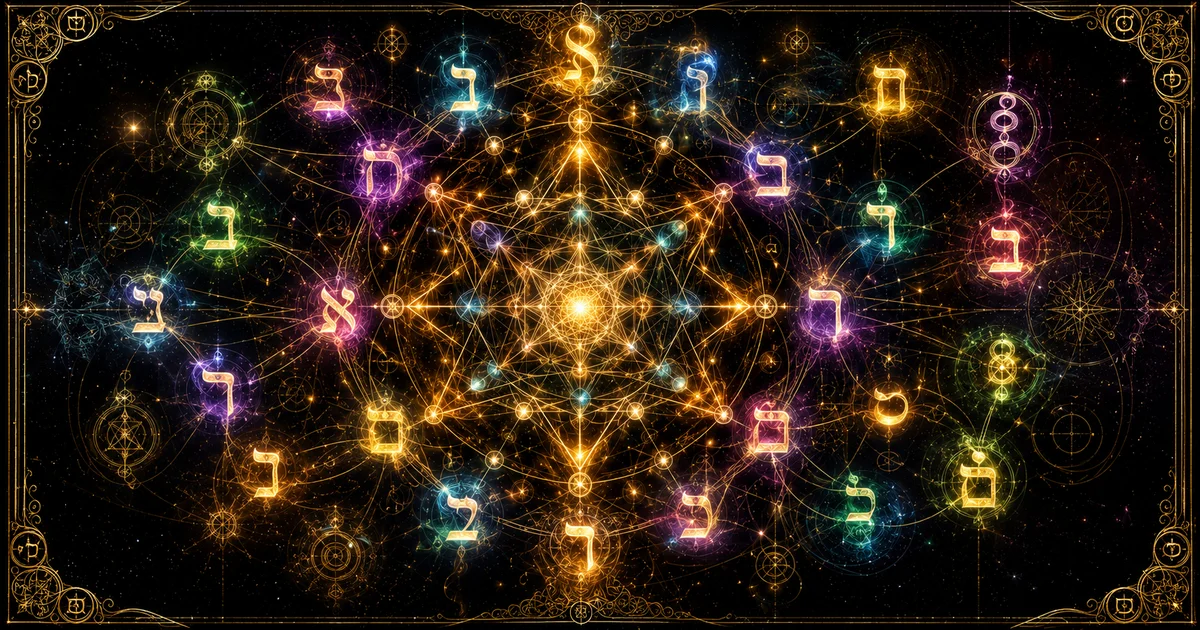
Cabalistic Numerology is a symbolic tradition that interprets names and birth dates through 22 archetypal values. It can be used as a reflective map for identity, habits, and questions about direction; it does not establish a soul's path, karmic facts, or a divine order.
The Foundation of the System
Unlike systems that reduce every result to a single digit, Cabalistic Numerology works with a broader symbolic range. Each vibration from 1 to 22 carries its own meaning, linked to a spiritual archetype. That wider range allows the interpretation to go deeper, because a 14 or a 19 is not treated as a mere reduction, but as a complete energetic state with its own lesson.
- The name is traditionally read as a prompt about how a person may express themselves in the world.
- The birth date shows the structure of the life path and its challenges.
- Repeated vibrations can highlight themes to examine, without fixing a destiny.
- Karmic language can frame lessons for reflection; it does not prove a past-life cause or an obligation.
How a Name Is Read
In Cabalistic Numerology, the name is not just a label. It is treated as a vibrational signature. The consonants and vowels of a name can be studied separately to understand external expression, inner desire, and the bridge between the visible and invisible parts of the person. This is why name analysis is one of the most important parts of the practice.
1. Vibration of Expression
This aspect shows how the person acts in the world, how they communicate, and how others tend to perceive them. It is the social face of the soul, the frequency that appears in daily interactions and professional life.
2. Vibration of the Soul
The soul vibration speaks about desire, motivation, and what deeply nourishes the inner self. It can offer a question about what a person may be seeking, without claiming access to an unconscious truth.
3. Karmic Lessons
Some numbers carry lessons that demand more attention, especially when they appear repeatedly in the map. These points do not represent punishment. They can be used to discuss areas where effort, maturity, and conscious change may be useful; they do not prove a soul's prior choice.
The Role of the Birth Date
The date of birth organizes the major cycles of life. It can organize questions about maturation, recurring experiences, and practical challenges; it does not prescribe what must happen or guarantee balance. When the date is combined with the name, the reading becomes much more complete because it places several symbolic themes side by side for reflection.
Practical Applications
Cabalistic Numerology can be used for self-reflection and name analysis; it should not replace qualified advice in health, financial, legal, or other high-stakes decisions. Many people use it to understand why certain patterns repeat in relationships, work, or family life. Others use it to reflect on names, signatures, and choices that may help them live more in tune with their path.
- Self-knowledge and personal development.
- Understanding recurring emotional or karmic patterns.
- Choosing or adjusting a name with greater awareness.
- Finding more favorable symbolic moments for important actions.
How to Begin Working With It
A good starting point is to observe your full name and your birth date without rushing to judge them. Notice what repeats, what feels strong, and what seems to challenge you. Then read those vibrations as invitations to evolve, not as fixed labels. Cabalistic Numerology becomes most useful when it is treated as a living map, one that supports reflection, responsibility, and spiritual maturity.
A method check for Cabalistic Numerology: A Complete Guide to the Soul's Numerical Map
The method becomes more useful when the reader can reproduce it and see where interpretation begins. Begin by recording the exact input and the reduction rule used by the calculator. Cabalistic numerology articles can discuss names, birth dates, or both, but these inputs should not be mixed. The result is a symbolic convention: its value depends on the table and reduction rule that the article names.
A small example
A useful check is to write the raw total beside the displayed value. If the raw total is 29 and the tool reduces it to 11, the reader can reproduce the step and see which convention was applied without treating 11 as proof of a special fate.
Keep the neighbouring concept separate
This is not the same as a clinical profile or a validated personality test. A number can suggest a question about attention, motivation, or timing; observations from ordinary life remain the evidence used to decide whether that question is useful.
Turn the result into an observation
Keep a short note for “Cabalistic Numerology: A Complete Guide to the Soul's Numerical Map”: the input, the displayed position, one interpretation, and one observation from ordinary life. Revisit it after a few days and allow the observation to change the question. This simple loop protects the reader from treating a first impression as a verdict.


A question for your next reading
What did the calculation actually use, which interpretive keyword feels relevant, and what observable example from the next week would support or challenge that keyword? If the prompt creates fear, pressure, or a consequential decision, pause and use ordinary evidence and qualified support.
Before closing the reading, check:
- name or date entered exactly as required
- raw total and reduction recorded
- interpretation compared with lived context
Share a numerology reading with care
When you share “Cabalistic Numerology: A Complete Guide to the Soul's Numerical Map”, explain which input and position produced the reading. Point to one observable detail from the article—the exact name or date input and one observable choice—and leave room for another person to disagree. A symbolic result can open a conversation, but it cannot label a partner, promise a financial outcome, or replace qualified advice.
A second pass through the number context
Return to “Cabalistic Numerology: A Complete Guide to the Soul's Numerical Map” and compare the first impression with the input, the reduction rule, and what the person actually experiences.
On a second pass through “Cabalistic Numerology: A Complete Guide to the Soul's Numerical Map”, compare the interpretation with the input, the reduction rule, and what the person actually experiences. If lived evidence points elsewhere, keep the observation and revise the question. That is a more honest use of a symbolic method than forcing the chart to deliver a verdict.
Did this guide help you?
Astro Ludico is an independent project. Your support helps us create more free tools and educational content.

About the Author: Kelwin Felipe
Creator of Astro Lúdico, software developer and independent researcher in Cabalistic Numerology, dedicated to translating ancestral wisdom into practical and intuitive tools for self-knowledge.
From study to practice
Put this into practice
Explore the related interactive tool: Cabalistic Numerology.
Continue the path
Next in this study path
Move forward through the sequence selected by the editorial graph.
What Is the Destiny Number in Cabalistic Numerology?
Learn what the Destiny Number means in Cabalistic Numerology, how it is calculated from your birth date, and how it can frame questions about direction and purpose.
What Is the Expression Number in Cabalistic Numerology?
Learn what the Expression Number means in Cabalistic Numerology, how it is calculated from the full birth name, and how it can frame communication style and outward energy.
What Is the Soul Number in Cabalistic Numerology?
Learn what the Soul Number means in Cabalistic Numerology, how it is calculated from the vowels of your birth name, and how it can frame questions about inner motivation and emotional depth.
Keep exploring
Related studies
Explore adjacent questions selected for this article.

Name Vibration in Numerology: A Symbolic Guide to Patterns
Learn how numerological traditions associate letters and numbers with symbolic patterns, while keeping personal choices and lived experience at the center.
Cabalistic vs. Pythagorean Numerology: Key Differences Explained
Understand the history, calculations, and spiritual focus of both Cabalistic and Pythagorean numerology, and find out which system is best for you.

Tree of Life and Numerology: A Symbolic Guide to the 10 Sefirot
Explore the Tree of Life, the 10 Sefirot and 22 paths as a symbolic tradition, and examine how this project connects those ideas to a numerological map.