On this page
- What Are the Ancestral Generation Lines?
- The Male Generation Line — Paternal Ancestry
- The Female Generation Line — Maternal Ancestry
- Spiritual and Material Dimensions: Why Position Matters
- The 22 Arcana and the Ancestral Lines
- Constructive and Challenging Expressions: The Plus and Minus
- Repeated and Mirrored Energies
- What Can an Ancestral Line Tell You?
- How to Read Your Ancestral Lines: A Step-by-Step Process
- A Simple Ancestral Reflection Exercise
- The Matrix Does Not Replace Your Family History
- Frequently Asked Questions
- Explore Your Ancestral Lines
Most people who begin exploring the Destiny Matrix quickly notice that the chart contains far more than a single central number. Running diagonally across the entire figure are two crossing lines that connect the four outer corners of the Matrix — and these lines represent something distinct from the personal energy channels: they carry the symbolic weight of your family lineage.
The idea that families pass down patterns — in behavior, in emotional life, in the way members relate to authority or to money — is not unique to esoteric systems. Therapists, historians, and family researchers have long noted that certain themes recur across generations: the same tendency to avoid conflict, the same difficulty with financial stability, the same quality of resilience under pressure. The Destiny Matrix, working within the tradition of Tarot-based symbolic numerology, offers a specific visual language for exploring these themes within your own chart.
This article explains how the two ancestral generation lines work, what positions they contain, how to locate them in your Matrix, and how to use them as a reflective tool rather than a predictive one. The goal is not to manufacture answers about your family history, but to generate questions worth sitting with.
What Are the Ancestral Generation Lines?
In the Destiny Matrix system, the ancestral generation lines are the two diagonals that cross through the center of the chart, forming an X shape. Each diagonal connects two of the four outer corners of the Matrix and passes through the central position, which represents the person whose Matrix is being read.
The two lines are traditionally named after the branches of the family they symbolize:
- Male Generation Line (Paternal Line): Upper Left corner → Center → Lower Right corner
- Female Generation Line (Maternal Line): Upper Right corner → Center → Lower Left corner
An important clarification: the terms 'male' and 'female' here refer to the paternal and maternal branches of the family tree, not to the gender identity of the person reading the Matrix. Every chart contains both lines, regardless of who the chart belongs to. A man reads both lines. A woman reads both lines. The ancestral generation lines describe symbolic family themes, not fixed gender roles.
Both lines pass through the center — the position that represents the chart owner themselves. In this sense, the two ancestral streams meet inside the individual. The symbolic reading suggests that we carry both lineages simultaneously, and that neither can be fully understood without the other.
The Male Generation Line — Paternal Ancestry
The Male Generation Line runs from the upper-left corner of the Matrix, through the center, to the lower-right corner. In the tradition of the Destiny Matrix, this diagonal is associated with the symbolic themes of the paternal branch of the family: the father's family and the father figures across generations.
The themes most commonly explored along this line include how authority is held and expressed, how structure and discipline are transmitted, the family's relationship with external achievement and material responsibility, the patterns around protection, boundary-setting, and ambition. It is worth emphasizing that these are symbolic categories, not fixed descriptions. The paternal line does not mean 'all men in your family were authoritarian.' It means that in this tradition, certain archetypal energies — action, structure, responsibility, the relationship with external power — are explored through this diagonal.
Upper Left: The Spiritual Dimension of the Paternal Line
The upper-left position is interpreted as the spiritual and psychological dimension of the paternal lineage. In the Destiny Matrix tradition, this position is read as the unresolved questions, the unfulfilled inner tasks, or the ideals and worldviews that were passed down through the father's family. The Arcana at this position may invite reflection on what values, fears, or beliefs about meaning and responsibility have been transmitted across generations on the paternal side.
Lower Right: The Material Dimension of the Paternal Line
The lower-right position corresponds to the material and physical dimension of the paternal lineage. This position is traditionally associated with themes of livelihood, health patterns, practical achievement, and the relationship with the external world that may run through the paternal branch. The Arcana here can be explored as a symbolic representation of how material challenges or strengths have manifested across generations on the father's side.
The Female Generation Line — Maternal Ancestry
The Female Generation Line runs from the upper-right corner of the Matrix, through the center, to the lower-left corner. This diagonal is associated with the symbolic themes of the maternal branch: the mother's family and the caregiving figures across generations.
The themes typically explored along this line include how emotions are expressed and received, intuitive knowing, the family's patterns around belonging and attachment, the way care and nurturing are given and withheld, the relationship with creativity, receptivity, and inner life. Again, these are symbolic categories. The maternal line does not describe what all women in the family experienced. It describes a set of archetypal themes — feeling, belonging, care, intuition — that the tradition maps onto this diagonal.
Upper Right: The Spiritual Dimension of the Maternal Line
The upper-right position holds the spiritual and emotional depth of the maternal lineage. It may be explored as the domain of emotional inheritance — the patterns of feeling that have been carried across generations on the mother's side, the unspoken grief or unexpressed longing that may have shaped how love and care were transmitted within the family.
Lower Left: The Material Dimension of the Maternal Line
The lower-left position reflects the material and somatic dimension of the maternal lineage. In this tradition, it is associated with themes of physical wellbeing, domestic life, fertility, the sense of safety and belonging, and the capacity to receive sustenance and stability. The Arcana at this position may invite reflection on how these themes have played out across generations on the maternal side.
Spiritual and Material Dimensions: Why Position Matters
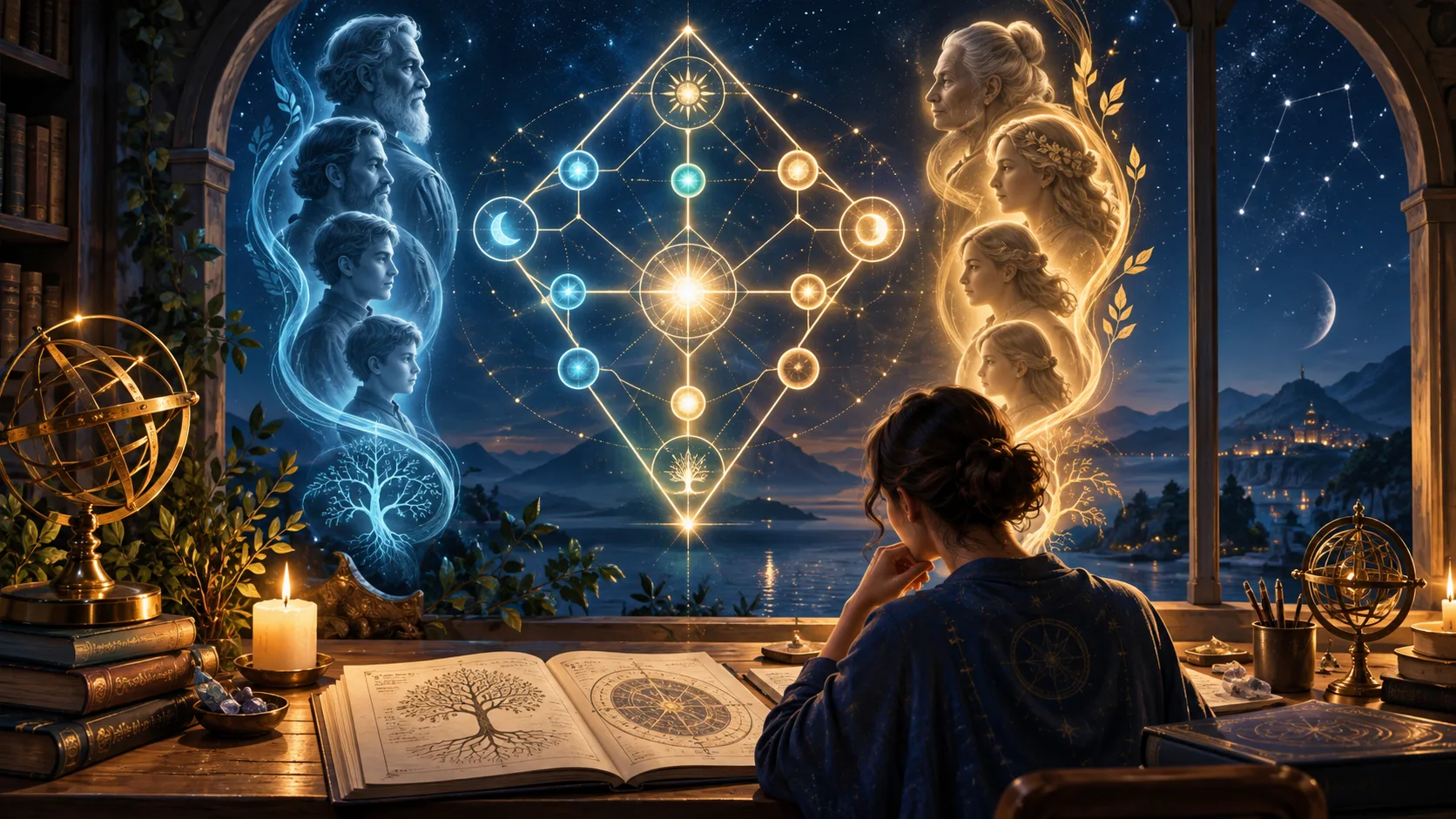
A core principle of the Destiny Matrix system is that the same Arcana carries different emphases depending on where it appears in the chart. An Arcana in the upper position on either ancestral line is read through the lens of inner life, values, and psychological or spiritual dimensions. The same Arcana in a lower position is read through the lens of material reality, practical life, and physical experience.
This means that before interpreting any number on the ancestral lines, the first step is always to identify its position. Reading the Arcana without knowing its position is like reading a sentence without knowing the subject — the words may be there, but the meaning is incomplete.
The Arcana is not interpreted in isolation. Its meaning in the Matrix depends on at least five factors: the Arcana itself, its specific position on the line, which ancestral line it appears on, the presence of repeated or mirrored numbers in the chart, and the relationship of this position to the rest of the Matrix.
The 22 Arcana and the Ancestral Lines
The Destiny Matrix uses the 22 Major Arcana of the Tarot as its symbolic vocabulary. Numbers 1 through 22 each correspond to an archetypal theme, and these themes are what appear at each position in the chart — including on the ancestral generation lines.
Each Arcana carries both constructive and challenging expressions. The tradition refers to these as the 'plus' and 'minus' poles of a given energy — a concept explained in more detail in the next section. What matters here is that no Arcana is inherently good or bad when it appears on an ancestral line. The Hierophant (5) might represent a tradition of strong ethical values in one family context and a pattern of rigid conformism in another. The Moon (18) might suggest strong intuitive gifts passed through the maternal line, or a recurring pattern of anxiety and illusion. The chart does not tell you which — it opens a question.
To illustrate how position changes interpretation: Arcana 4 (The Emperor) in the upper-left position on the paternal line might invite reflection on how authority and structure were conceived at an ideological or psychological level across generations on the father's side. The same Arcana 4 in the lower-right position would shift the focus toward material manifestation — patterns of control or stability in practical, financial, or physical life.
Constructive and Challenging Expressions: The Plus and Minus
The Destiny Matrix tradition works with the concept of 'plus' and 'minus' expressions for each Arcana. These terms can be slightly misleading if taken too literally: 'minus' does not mean the energy is bad, harmful, or fixed. 'Plus' does not guarantee a positive outcome. They are better understood as two ends of a spectrum — the constructive, integrated expression of an archetypal energy, and the reactive, unresolved, or shadowed expression of the same energy.
On the ancestral lines, this distinction is particularly useful. The question the tradition invites is not 'did my ancestors suffer because of this energy?' but rather 'in what way might this archetypal theme have expressed itself across generations, and in what direction does it tend to move in my own life?' A pattern identified on the paternal line might be recognized in a story a family member told, or in a recurring dynamic that appears in one's own professional life. Or it might not resonate at all — in which case the chart has simply not found a match with this particular family's history.
Repeated and Mirrored Energies
One of the questions that comes up most often among people studying the ancestral generation lines is what it means when the same Arcana appears in multiple positions — for instance, when the same number appears on both the paternal and maternal lines, or when it recurs in several different zones of the Matrix.
Within the Destiny Matrix tradition, repetition is treated as a form of symbolic emphasis. An Arcana that appears multiple times in the chart — and especially one that appears on both ancestral lines — is considered a prominent theme in the symbolic reading. The tradition suggests that this energy may be particularly significant for the person to work with consciously.
However, it is important not to leap from 'this Arcana is repeated' to 'this specific event must have happened in my family.' Repetition in the chart is a symbolic signal, not a factual record. The meaningful next step is to compare the repeated Arcana with what you actually know about your family — the stories you have heard, the patterns you have observed, the themes that seem to surface across different branches. Sometimes the connection is striking and clarifying. Sometimes it is not there. Both outcomes are informative.
What Can an Ancestral Line Tell You?
Being clear about what the ancestral lines can and cannot offer is part of what makes working with the Destiny Matrix responsible and genuinely useful.
| What the Matrix can help you explore | What it cannot prove |
|---|---|
| Symbolic family themes worth reflecting on | Hidden family secrets or suppressed events |
| Recurring behavioral or emotional patterns | Specific ancestral events or experiences |
| Perceived strengths in your lineage | Medical or psychiatric diagnoses |
| Your relationship with authority or care | Inherited diseases or physical conditions |
| Different ways an Arcana might express itself | Fixed psychological characteristics |
| Personal reflection questions about family life | Your predetermined destiny |
How to Read Your Ancestral Lines: A Step-by-Step Process
- Generate your Destiny Matrix using a reliable calculator.
- Locate both diagonal generation lines on the chart: upper-left to lower-right (paternal), upper-right to lower-left (maternal).
- Record the Arcana at each of the four outer corners and at the center.
- Before interpreting any number, identify its position: upper (spiritual/psychological) or lower (material/practical), and which line it belongs to.
- Read each Arcana in both its constructive and challenging expressions.
- Note any repeated numbers — both within the same line and across both lines.
- Compare the two ancestral lines with each other: do they share any numbers? Do they seem to tell contrasting or complementary stories?
- Compare what the chart suggests with what you actually know about your family history on each side.
- Identify one theme that genuinely resonates with your experience.
- Turn that theme into a practical reflection question you can sit with over time.
A Simple Ancestral Reflection Exercise
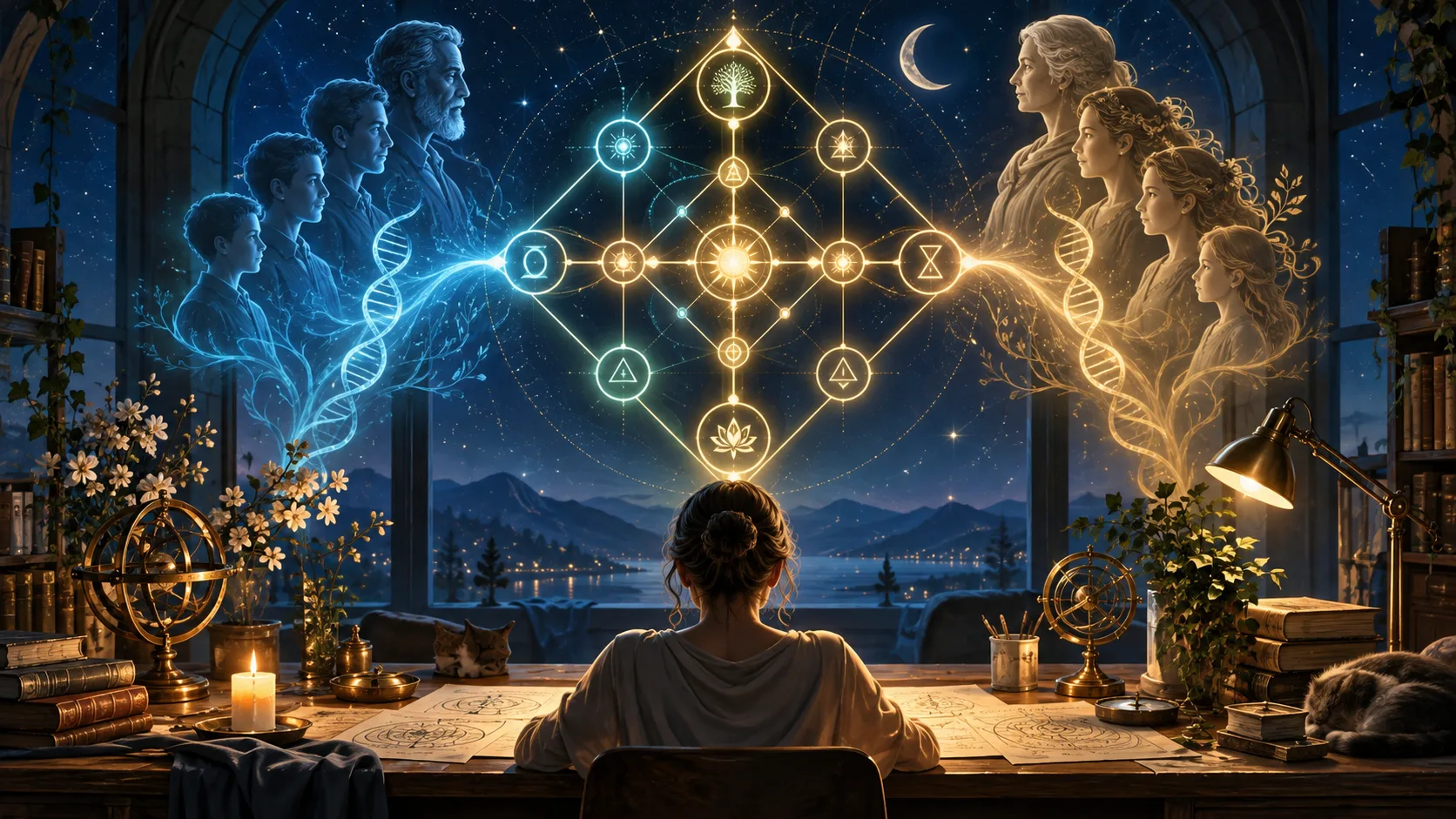
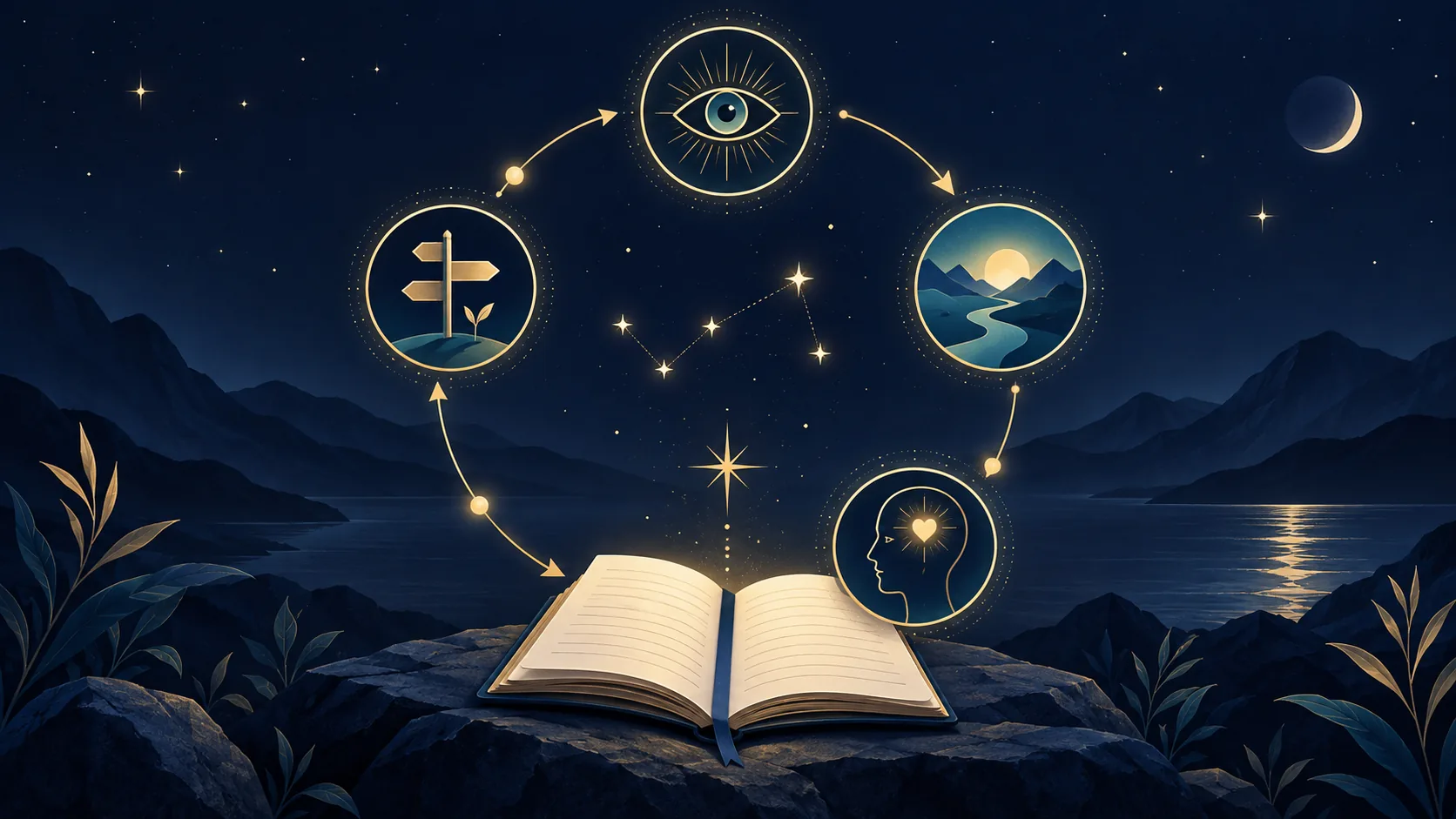
After locating and reading your ancestral generation lines, try this three-question exercise. Write the answers in a journal rather than just thinking through them — the act of writing tends to surface more specific and honest material.
- Observation: What pattern is actually visible in my Matrix on this line? (Describe what the Arcana and position suggest, without immediately interpreting it as a personal statement about your family.)
- Family Context: Where, if anywhere, do I recognize this theme in what I know about my family history? (Be specific. If it resonates, name the story or the person. If it does not resonate, note that too.)
- Choice: What constructive expression of this Arcana could I practice in my own life — not because the chart tells me I must, but because it seems genuinely useful?
Finally, consider one larger question: What do I want to consciously carry forward from my family heritage, and what would I like to express differently in my own life? This question belongs to you, not to the chart.
The Matrix Does Not Replace Your Family History
The Destiny Matrix is a symbolic system. It works with archetypes and patterns, not with biographical facts. The chart can prompt reflection, open conversations, and highlight themes worth exploring — but it cannot tell you what actually happened in your family, what your ancestors felt, or what specific experiences shaped the people who came before you.
The most honest and responsible way to use the ancestral generation lines is to treat the chart as a starting point for inquiry, not a destination. If an Arcana on the paternal line prompts you to think about how authority was expressed in your father's family, that is the chart doing its work — it has opened a question. The answer, if there is one, comes from memory, from family stories, from conversations with relatives, and from your own lived experience. The chart generates questions; your real family history provides the material for reflection.
This distinction matters because it keeps the reading honest and genuinely useful. A chart that generates questions is more valuable than a chart that claims to reveal facts — because questions can be sat with, investigated, and gradually answered, while claims that cannot be verified tend to close inquiry rather than open it.
Frequently Asked Questions
What is the Male Generation Line in the Destiny Matrix?
The Male Generation Line is one of the two diagonal lines that cross the Destiny Matrix chart. It runs from the upper-left corner, through the center, to the lower-right corner. In the Destiny Matrix tradition, this diagonal is associated with the symbolic themes of the paternal branch of the family: patterns connected to authority, structure, discipline, material responsibility, and the relationship with external power. The term 'male' refers to the paternal lineage, not to the gender of the chart owner.
What is the Female Generation Line in the Destiny Matrix?
The Female Generation Line runs from the upper-right corner of the Matrix, through the center, to the lower-left corner. It is associated with the symbolic themes of the maternal branch of the family: patterns connected to emotional life, intuition, care, belonging, creativity, and receptivity. As with the Male Generation Line, the name refers to the maternal lineage, not to any gender characteristic of the person reading the chart.
Do both lines appear in every Destiny Matrix?
Yes. Both generation lines appear in every chart, regardless of who the chart belongs to. Every person has both a paternal and a maternal ancestral line in their Matrix, and both are always present and readable. Neither line is optional or absent.
Does 'male' mean the chart owner must be a man?
No. The Male and Female Generation Lines describe the paternal and maternal branches of the family tree, not the gender of the person whose Matrix is being read. A woman's Destiny Matrix contains the Male Generation Line (representing her paternal ancestry) just as a man's chart contains the Female Generation Line (representing his maternal ancestry). Both lines are meaningful for every chart owner.
What does it mean when the same Arcana appears on both ancestral lines?
When the same Arcana appears on both the paternal and maternal generation lines, the Destiny Matrix tradition treats this as a symbolic emphasis — the theme carried by that Arcana may be particularly significant for the person to notice and work with consciously. This is not an interpretation of a specific historical event. It is a signal that a certain archetypal energy appears prominently in the symbolic reading of both ancestral branches. Whether that resonates with actual family history is something to explore by comparing the chart with what you know about your family.
Can the Destiny Matrix reveal family secrets?
No. The Destiny Matrix is a symbolic system, not an investigative or historical record. It cannot reveal events that happened, conversations that were had, or experiences that were suppressed. What it can do is surface archetypal themes that may resonate with patterns you already recognize — or prompt you to look more carefully at aspects of your family history that you have not fully considered. The chart generates questions; it does not uncover hidden facts.
Can the ancestral lines predict what will happen to me?
No. The Destiny Matrix is presented by Astro Ludico as a symbolic and educational tool, not a predictive instrument. The ancestral generation lines describe archetypal themes associated with the paternal and maternal branches of the family — they are a framework for reflection, not a forecast of future events. What you do with the themes the chart surfaces is entirely your own choice.
How should I interpret a repeated Arcana on the ancestral lines?
Treat repetition as emphasis rather than as proof. A repeated Arcana appears with more symbolic weight in the chart — the tradition suggests it is worth paying particular attention to. Study both the constructive and challenging expressions of that Arcana. Then compare what it suggests with your actual knowledge of your family on the relevant side. If the connection is meaningful, explore it further. If it does not resonate with what you know, that is also useful information — the chart may not be finding a match with your specific family history.
Which is more important: the ancestral lines or the rest of the Matrix?
Neither is more important in isolation. The Destiny Matrix is designed to be read as a whole. The ancestral generation lines provide context for understanding family themes that may be operating in the background of a person's life — but they gain their full meaning in relation to the central positions, the personal energy channels, and the overall pattern of the chart. Reading only the ancestral lines without the rest of the Matrix would be like reading only the footnotes of a book.
Explore Your Ancestral Lines
The best way to make this article practical is to apply it to your own chart. If you have not yet generated your Destiny Matrix, Astro Ludico's Destiny Matrix calculator will produce your complete chart, including all positions on both ancestral generation lines.
Once you have your chart in front of you, return to the step-by-step process described above. Locate the four corner positions, identify the Arcana on each diagonal, and begin with position before interpretation. The ancestral lines will mean more when you are reading your own numbers than when you are reading about the system in the abstract. That is the nature of symbolic work — it comes alive in contact with specific material.
Did this guide help you?
Astro Ludico is an independent project. Your support helps us create more free tools and educational content.
About the Author: Kelwin Felipe
Creator of Astro Lúdico, software developer and independent researcher in Cabalistic Numerology, dedicated to translating ancestral wisdom into practical and intuitive tools for self-knowledge.
Content graph
The pillar guide for this theme
Build the broader context before exploring this focused article.
Destiny Matrix Complete Guide: Structure, Positions, Arcana, and Interpretation
Read first
Helpful foundations
These articles establish the concepts used here.
From study to practice
Put this into practice
Explore the related interactive tool: Destiny Matrix.
Keep exploring
Related studies
Explore adjacent questions selected for this article.

The 3 Life Phases of Purpose in the Destiny Matrix
Explore how your development themes can be revisited through the Material, Spiritual, and Divine purposes across different ages.

The Karmic Tail in the Destiny Matrix: A Symbolic Reading of Recurrent Patterns
Learn how the lower triad is calculated in the Destiny Matrix and how to use it as a symbolic prompt for reflecting on recurring patterns—without treating it as proof of past lives or a method of healing.

Tree of Life and Numerology: A Symbolic Guide to the 10 Sefirot
Explore the Tree of Life, the 10 Sefirot and 22 paths as a symbolic tradition, and examine how this project connects those ideas to a numerological map.